Opt Out Guides
Taboola Opt Out Guide
Before You Opt Out of Taboola, Check Your Exposure
Privacy Writer
A. J. MercerAva J. Mercer
Updated
Read
5 min
Before You Opt Out of Taboola, Check Your Exposure
Removing your personal data from Taboola matters because ad identifiers can connect your name, address, or phone number to what you see online. Taboola generally uses signals from its network on websites and digital properties, along with cookies and similar tools, to personalize what appears.
How to opt out of Taboola
Open the official privacy policy, go to the data subject access request portal, enter your email/phone, and confirm deletion. It usually takes 7–14 days for the processing of your personal data, and you may need to repeat this for each device or browser.
Checklist:
- Open the privacy page
- Select the opt-out option
- Confirm deletion
- Save confirmation
- Set a reminder to re-opt-out
Find out if your private details were exposed
Taboola – Quick Facts
| Parameter | Value |
| Domain | taboola.com |
| Data Types | contact details, general location information, digital identifiers |
| Opt-out Methods | web form/email |
| Identity Verification | confirmation email or code |
| Typical Response Time | 7–14 days |
| Re-listing Risk | medium |
Taboola is committed to privacy and security and the highest level of transparency. The privacy policy and cookie policy explain that personal information is collected when you interact with content and advertisements served through a content discovery platform. They also describe data security practices designed to reduce unauthorized access and support privacy practices under data protection laws.
Common data you may find:
- Names (and known aliases)
- Email addresses
- Hashed email address
- Phone numbers
- Mobile advertising IDs
- Current and past addresses (where provided)
- IP address
- Device or browser identifiers
- Device and operating system
- Cookie IDs stored as pseudonymized data
- Interest categories tailored to your interests
- Event logs tied to ads and content
Step-by-Step Guide
Open the official privacy policy
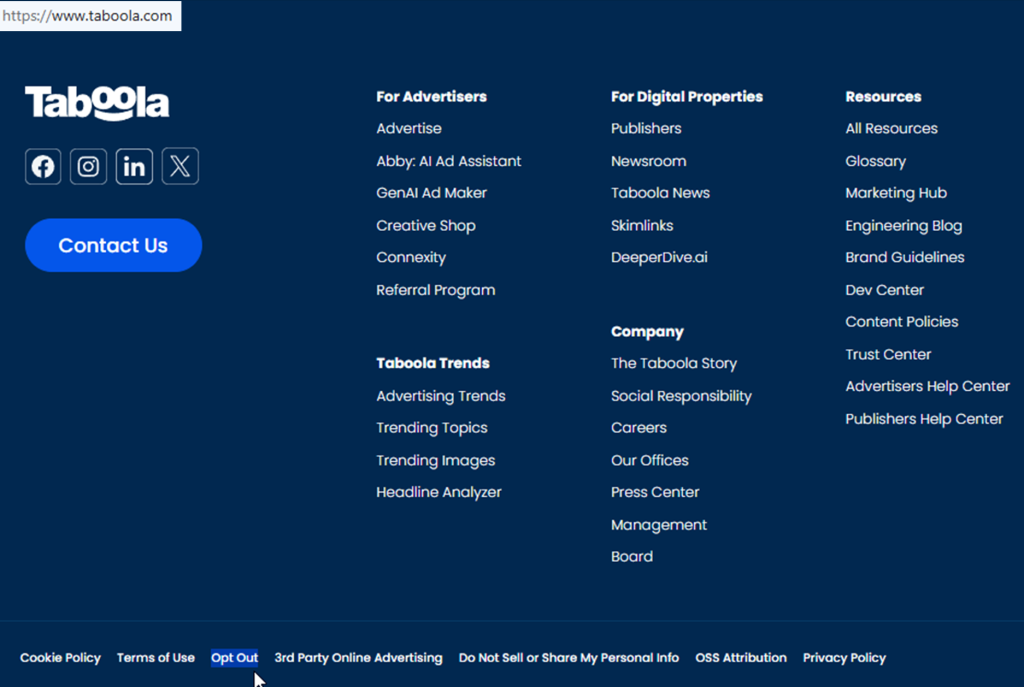
Open the privacy policy page and find the section about consumer choices, data protection laws, and privacy practices. When you see links for “Data Subject Access Request” and similar controls, look for Taboola’s data subject access request and open the portal. If you capture images for support, blur personal information and other personal data. A small hint: the trust center page may also point you to regional choices.

Select the opt-out option
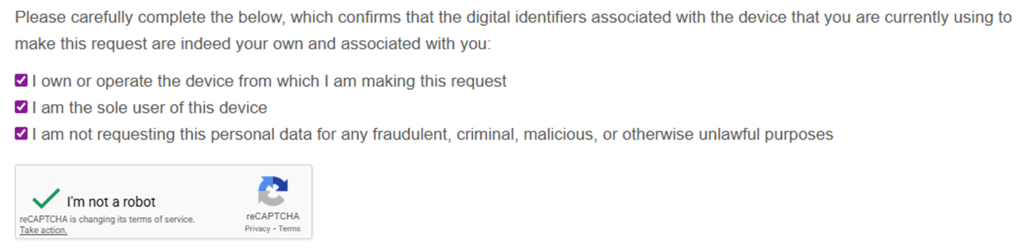
On the request page, enter the identifiers requested (often email, phone, or a cookie ID), review the disclosure text, and submit. This supports transparency and control, and Taboola supports initiatives to offer greater transparency and control at a level of transparency and control. The policy outlines the collection and use of data and may process your personal data to process digital identifiers based on your browsing across different websites. Blur personal data in any images and avoid showing your full IP.
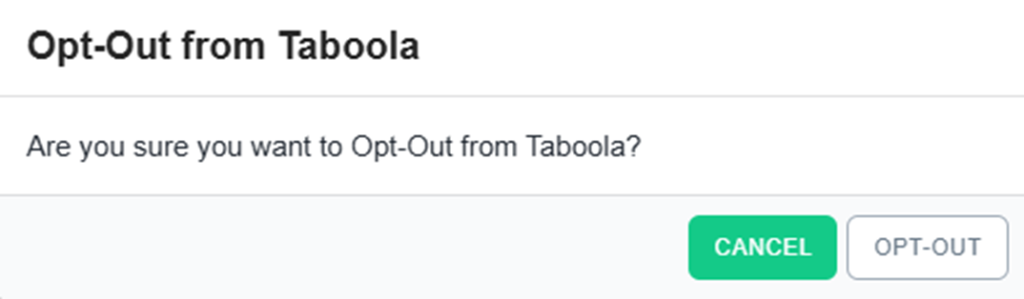
Confirm deletion
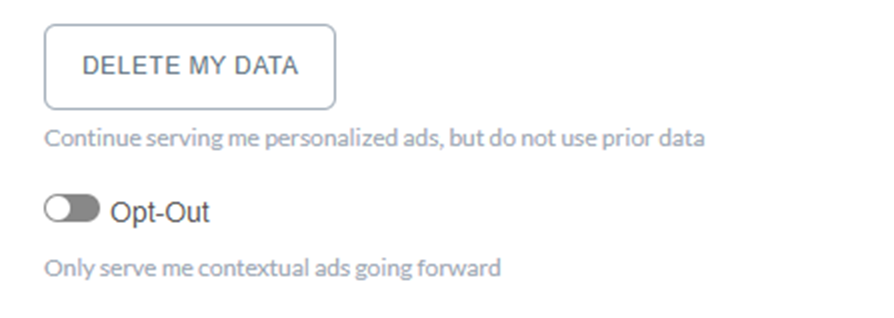
After you submit, look for an on-page confirmation. Keep confirmation for your records so you can use the right to request that Taboola provide an update later. If you are asked to delete your personal data, save both the submission receipt and the verification note. You can request to cease or restrict processing of your personal data for some uses, including processing of your personal data tied to cookies.

Track confirmation & timeline
Record the date you submitted and any reference number. A request under global privacy controls can take 7–14 days, sometimes a shorter period of time, depending on verification. If nothing arrives after 14 days, resubmit once from the same device and browser. Store the date and receipt in a notes app. Set a calendar reminder.
Timelines, Verification & What to Expect
Most Taboola requests show an on-page receipt right after submission. Taboola provides you with access to the personal data you request. Taboola references the Interactive Advertising Bureau’s frameworks for some U.S. signals. Typical response time is 7–14 days for updates, but it can vary by region and by request type. If you get no confirmation after 14 days, try again once from the same device or browser and check your spam folders. If needed, email support @taboola.com. If you need help, look for access details on the request page and in the privacy policy.
Edge Cases & Troubleshooting
- No access to the original email/phone: Use the same device that saw the widgets and submit via the Taboola data subject access request portal.
- “Record not found”: Clear cache, reload, and try again; some controls rely on current cookies rather than an account.
- CAPTCHA or submission errors: Turn off VPN or strict blockers, refresh, and retry; try another browser if needed.
- Verification code not arriving: Check spam folders, wait 30 minutes, then resend once.
- Form rejects the request by region (EU/UK/CA): Use the data subject access request portal; some tools are limited by state rules.
- Account closure confusion: If you used a login for Taboola’s products, follow the account settings to close it; if you need to cancel email messages, use the unsubscribe link in the message.
- Re-submitting after a failed attempt: Use the same identifiers and keep the confirmation note for comparison.
Will my data reappear?
Sometimes, settings seem to reset because the choice is stored as a cookie. Cookies can be cleared, blocked, or replaced. Also, new identifiers can be created when you reinstall apps, switch devices, update your browser, or browse in a different profile. In the online advertising ecosystem, partner feeds, resellers, and measurement vendors can reintroduce similar signals even after a request. To reduce repeat issues, keep confirmation messages, set a 3–6 month reminder, and re-submit quickly after cookie clearing. If you notice the same pattern again, check related removals for other ad-tech vendors you use.
Manual vs Assisted Removal
Manual:
Pros
- More direct control over the use of your personal data;
- you can review each privacy policy and cookie policy page yourself;
- it works well if you only use one device or browser.
Cons
- Time investment and repeat monitoring;
- extra steps after cookie clearing;
- you may need to reach multiple data partners.
Assisted:
Pros
- Faster flow with tracking dashboard;
- support for verification and follow-ups;
- recurring checks and reminders.
Cons
- You still must confirm via email/code;
- you share identifiers as personal information;
- coverage depends on the service scope.
We remove your data for you - faster, verified, trackable.
Discover Which Sites Share Your Private Details—Instantly and Free.
FAQ
These widgets are often embedded on the publisher’s site, so blocking can be inconsistent. For privacy controls, start from the privacy policy, open the data subject access request portal, submit identifiers, and verify. Repeat per device, and save confirmation.
Taboola News is a built-in feed on certain devices. In Android settings, disable the feed or turn off its content permissions. If you also want to limit ad identifiers, submit a request through the data subject access request portal and complete verification. Keep the on-page receipt so you can follow up if needed.
It can appear when pages load Taboola widgets. Blocking may reduce requests, but it does not replace formal privacy choices. Use the cookie policy and privacy policy links to reach the official form, then verify the request and keep your confirmation.
The setting is stored in a cookie, so it can be different per browser. If you clear cookies or switch profiles, you may need to submit again. Use the same email or phone number where requested and keep your confirmation so you can compare results later.
Recommendations can feel tailored to your interests. Use the request page controls to adjust interest-based settings, then review your browser settings for third-party cookies.
The most direct route is the data subject access request portal referenced in the privacy policy. For some U.S. state residents, the consumer rights portal may appear instead. Submit the identifiers the page asks for, complete verification, and save the confirmation.
Re-submit after clearing cookies, switching devices, or creating a new browser profile.
On the request page, enter the identifiers requested and pass verification. If you do not receive any confirmation after 14 days, resubmit once from the same device or browser.
You can request access, correction, or to cease or restrict processing of your personal data. Use the data subject access request portal to submit, then pass verification. Save the disclosure text and confirmation so you have a clear record of what you asked for.
Taboola notes that the consumer rights portal is limited to certain residents, while others should use the data subject access request portal. If the page blocks you by region, try again from your own device, then use the global request page instead.

Posted by Ava J. Mercer
More Data Brokers & AdTech Removal Guides
- 33Across Opt Out Guide
- Acxiom Opt Out Guide
- AdDefend Opt Out Guide
- AdElement Opt Out Guide
- AdMarketplace Opt Out Guide
- Adstra Opt Out Guide
- Alesco Data Opt Out Guide
- Allant Group Opt Out Guide
- Anteriad Opt Out Guide
- Appier Opt Out Guide
- Aristotle Opt Out Guide
- Arity Opt Out Guide
- Buyerlink Opt Out Guide
- Complete Mailing Lists Opt Out Guide
- CoreLogic Opt Out Guide
- Data Axle Opt Out Guide
- Epsilon Opt Out Guide
- Exactag Opt Out Guide
- FourLeafData Opt Out Guide
- FullContact Opt Out Guide
- Gemini Opt Out Guide
- Giant Partners Opt Out Guide
- Habu Opt Out Guide
- Kochava Opt Out Guide
- LexisNexis Opt Out Guide
- LiveRamp Opt Out Guide
- Lotame Opt Out Guide
- MediaWallah Opt Out Guide
- Oracle Opt Out Guide
- Outbrain Opt Out Guide
- PacificEast Opt Out Guide
- PeopleConnect Opt Out Guide
- PubMatic Opt Out Guide
- PubWise Opt Out Guide
- Quantcast Opt Out Guide
- Site Impact Opt Out Guide
- Statara Opt Out Guide
- Taboola Opt Out Guide
- VenPath Opt Out Guide
- Verisk Opt Out Guide