
Privacy Guides
How to Remove Public Records from the Internet: What Can Be Deleted
You usually cannot completely delete a public record from the Internet, but you can often reduce or restrict where it appears. The right method depends on whether the information is an original government record, a data-broker or people-search copy, or a Google result. Government records may require correction, redaction, sealing, expungement, or confidentiality, while third-party copies can often be removed through opt-outs and search results may be de-indexed separately.
See where your personal data appears online
Privacy Writer
A. J. MercerAva J. Mercer
Updated
Read
5 min
See where your personal data appears online
What Is a Public Record, and Why Is It Online?
A public record is information created, received, or maintained by a government body as part of public business. The Virginia Public Records Act, for example, defines it as recorded information documenting a transaction or activity by or with a public officer or agency.
Public records contain:
- Names.
- Addresses.
- Parcel data.
- Case filings.
- License status.
- Business roles and more.
Records include deeds, court dockets, arrest information, voter files, licenses, marriage/divorce indexes, and corporate filings. Some fields are considered public; others are restricted.
PACER says it provides access to more than 1 billion federal court documents. People can find personal information directly in public records, while a data broker may use public records to compile a broader profile. That information can then spread to other databases.
Which Type of Public Record Are You Trying to Remove?
Classify the record first. For each item, check who controls it. Verify which personal details are exposed. Check whether the page is government-run or third-party:
- Property records: Recorder, assessor, or land-records office. These records may also include the owner’s name, property and mailing address, parcel number, deed, and mortgage data.
- Court records: Court clerk or judiciary. Names, addresses, case numbers, exhibits, dates, and disposition.
- Arrest records: Police, sheriff, court, corrections agency, or state repository. Booking data, charges, mugshots, and outcomes.
- Voter registration: Election authority. Residential addresses, registration fields, and voter-status information.
- Professional licenses: Licensing board. License numbers, addresses, disciplinary histories, and contact data.
- Marriage/divorce records: Vital-records office or court. Names, dates, docket details, and available documents.
- Business filings: Secretary of State or corporations agency. Registered agents, organizers, officers, managers, and addresses.
Is This the Government Source, a Third-Party Copy, or a Google Result?
The same fact can exist at three layers. Removing one does not change the others.
| Layer | Who Controls It | Legal Limit | Typical Remedy | What Removal Actually Achieves |
| Original government record | Agency, court, recorder, board | Open-records, retention, court, and state rules | Correction, redaction, confidentiality, sealing, expungement | Changes or restricts the authoritative record if allowed |
| Third-party copy | People-search site, publisher, data broker | Privacy law, consumer-reporting rules, public-record exceptions | Opt-out, dispute, suppression | Removes that copy. The source may remain |
| Google result | Search engine | Google policy, legal duties, public-interest review | Privacy request, legal request, stale-content refresh | Changes search results. The source may remain |
Google Search Help explains that qualifying private information can be removed from Google Search without being removed from the hosting website. De-indexing changes discovery, not the original record.
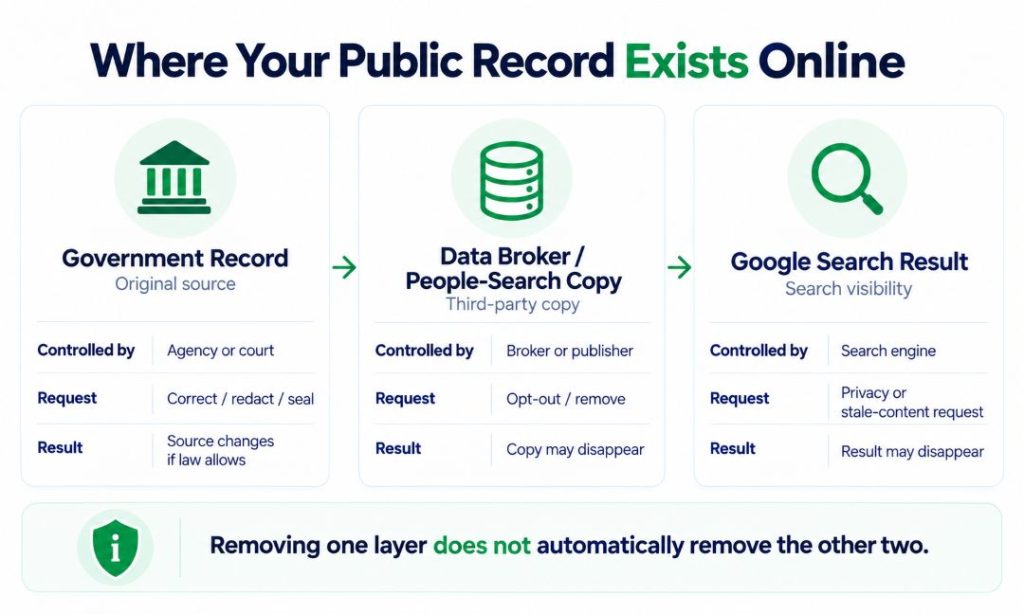
There are three layers where a public record can appear online:
- The original government source.
- A data broker or people-search copy.
- A Google search result.
Removing data from one layer does not automatically remove it from the others. Each layer may require a separate action.
What Can Be Deleted, Redacted, Sealed, or Expunged?
The remedy depends on the jurisdiction. Record sealing restricts public access. Expungement can have a broader effect. Nonetheless, definitions vary.
| What Happens to the Record | Destroyed/Isolated vs. Restricted | Who Can Still View It | Typical Eligibility |
| Deletion/purge | Removed where law permits | Depends on retention rules | Incorrect, unlawfully held, or specifically eligible record |
| Redaction | Record remains; fields are hidden | General public sees a limited copy; agency or court may retain the full version | Protected identifiers, addresses, minors, filing errors |
| Sealing | Record remains, but access is restricted | General public is usually blocked; courts, law enforcement, or specified bodies may retain access | Disposition, offense type, waiting period |
| Expungement | May be destroyed, isolated, or legally suppressed | Access varies; courts, law enforcement, or licensing bodies may retain limited access under some laws | Often applies to eligible arrests, non-convictions, or specified convictions |
PACER states that sealed federal documents are unavailable to the public. Its separate guidance on information available through PACER notes that specified identifiers are removed or redacted, including Social Security numbers, financial account numbers, minors’ names, and birth dates.
When Redaction Is More Realistic Than Deletion
For many public records, deletion isn’t an option because the government has a legal duty to retain them. Redaction is more realistic when one protected field creates the problem.
Ask whether an address, account number, birth date, minor’s name, or other sensitive information can be hidden. If information is published without the required redaction, contact the clerk. Some changes require a judge.
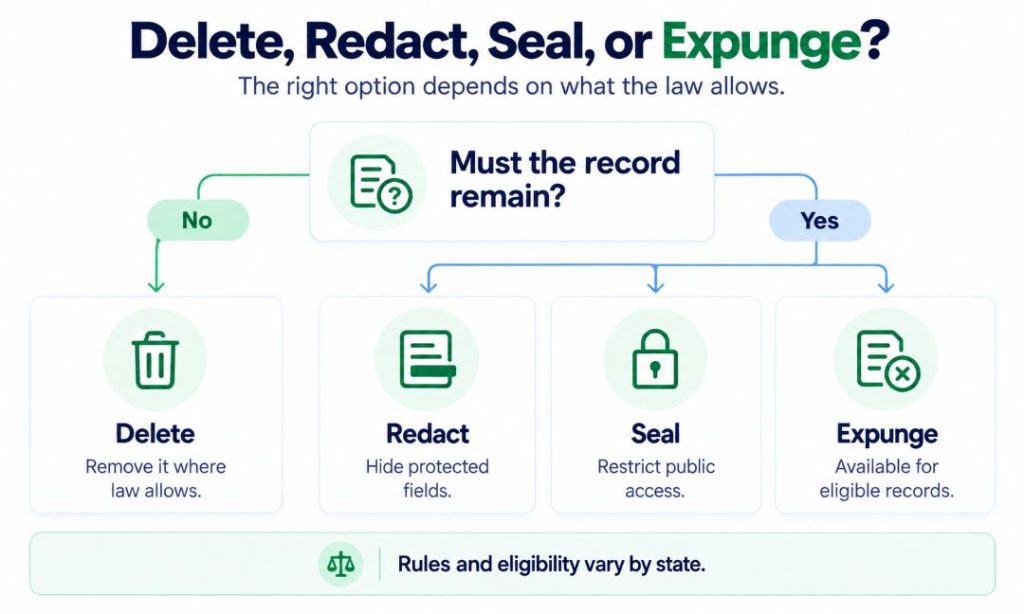
The difference between deleting, redacting, sealing, and expunging a public record is shown above. The outcome depends on whether the record must legally remain available. Eligibility and the exact effect of each remedy vary by state law.
Who Controls the Record, and Who Should You Contact First?
Start with the original custodian. If the source remains unchanged, information removed from commercial copies may return.
The practical steps to reduce exposure are:
- Contact the agency, recorder, election office, licensing board, or court clerk.
- Correct, redact, seal, or restrict the source if a procedure exists.
- Ask each people-search site or broker to remove your information.
- Ask Google to remove eligible results or refresh outdated content.
- Monitor for new copies.
There is no universal way to opt out of public records. Ask which law controls disclosure. Verify whether redaction, confidentiality, or a substitute address is available.
What Information Should You Include in a Removal or Redaction Request?
A data removal request should identify the record without supplying unnecessary private details. If your goal is to remove personal information, ClearNym can help organize suppression requests for eligible commercial profiles while you handle the government source separately.
The request should be specific enough for the recipient to locate the exact record. Include the relevant URL, parcel ID, case number, license number, or profile URL, and use your name exactly as it appears in the record. Then identify the field you want removed or corrected and state the remedy you are requesting and why.
If supporting evidence is required, reference or provide the relevant sealing order, Address Confidentiality Program document, or correction record through the official process. Avoid sending full financial information or extra personally identifiable information unless an official secure submission method specifically requires it.
How Do You Remove a Home Address from Property Records?
If you are researching how to hide your address from public records, begin with the county recorder and assessor. Ownership is commonly public information, so a valid deed may remain even when your goal is to remove your address.
Ask about protected-person suppression, an alternate mailing address, or reduced online display. After the source is changed, seek removal of copied profiles and stale listings. Historical deeds, mortgages, or tax records may remain.
Should You Create an LLC or Trust to Protect Your Address?
An LLC or trust can reduce the direct use of your name or home address in some future transactions, but it is not retroactive. Formation filings, registered-agent data, deeds, financing, and prior ownership records may still create a connection.
Before transferring property, ask an attorney about tax, lending, insurance, and disclosure consequences. The goal is to limit unnecessary personal details in public filings.
What If You Are a Victim of Stalking or Domestic Violence?
Use protected-person procedures before ordinary opt-outs. Address Confidentiality Programs can provide substitute mailing addresses and restrict residential disclosure in covered systems.
The National Association of Secretaries of State’s January 2026 ACP briefing lists ACPs or related resources in 46 states; Alaska, North Dakota, South Dakota, and Wyoming were listed without programs. ACPs commonly address domestic violence, stalking, harassment, or similar threats.
Rules vary. Virginia, for example, permits eligible victims of domestic violence, stalking, child abduction, or sexual violence to apply for its ACP. Under the Virginia ACP statute, covered state and local agencies generally must accept the designated address unless an exemption applies.
When exposed information creates a safety risk, prioritize residential addresses, voter files, sensitive personal information, and personal information on social media. These measures can reduce the exposure of personal and location data and lower the risks of stalking or identity theft.
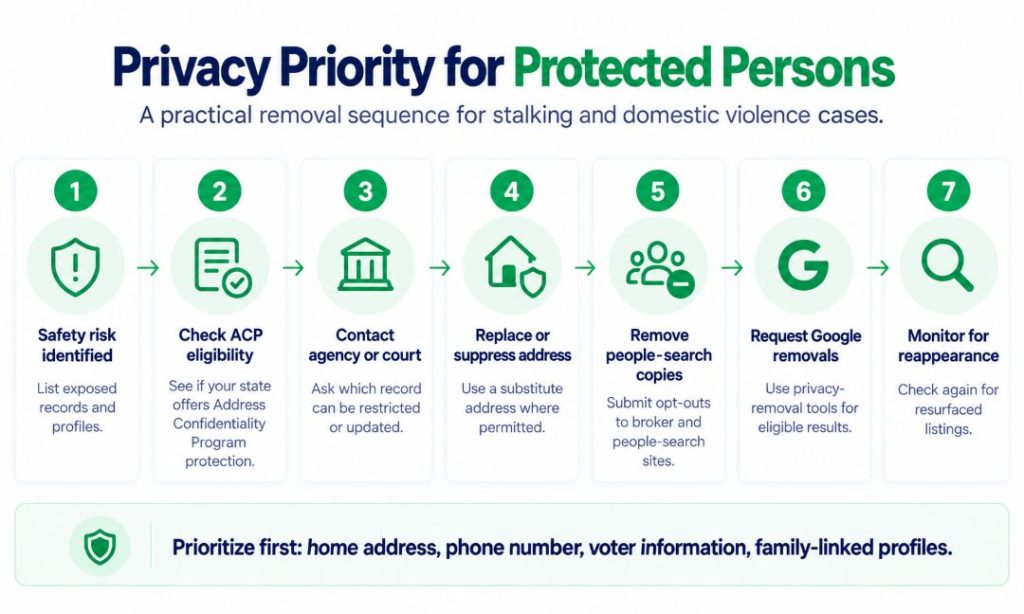
This infographic outlines a seven-step privacy process for protected persons. It also emphasizes ongoing monitoring and prioritizing high-risk details.
Can Court or Arrest Records Be Removed from the Internet?
Sometimes. Eligibility depends on:
- Jurisdiction.
- Disposition.
- Offense type.
- Waiting period.
- Relief available.
If a record is sealed or expunged, obtain the order. Use it to request updates to downstream databases.
To remove yourself from background check websites, dispute inaccurate or restricted material with the reporting company and provide the corrected disposition or order. If the source is wrong, correct that record too.
Why Removing a Data-Broker Copy Does Not Delete the Original Record
A data broker can suppress a profile while the courthouse, recorder, board, or election office keeps publishing the source. Removing information from data broker databases therefore does not rewrite the government record.
The FTC’s data-broker study found that one company held more than 700 billion aggregated data elements and information on 1.4 billion consumer transactions, while another added 3 billion new records monthly. Seven of nine companies studied supplied data to one another.
That network explains why data brokers collect your data from different sources and why information about people spreads between companies. Much of your personal information may be recombined, and a company may share or sell your information.
How to Remove Copies from People-Search Sites
To learn how to remove information from people-search sites, locate the profile. Save its URL. Use the official opt-out, suppression, or correction process.
Follow this sequence:
- Confirm the profile belongs to you.
- Complete required verification.
- Request the removal of personal information.
- Recheck after the stated processing period.
- Repeat the process for mirror sites and affiliated services.
ClearNym can help remove your personal information from eligible people-search and data broker sites. It can also help you remove your personal info from duplicate profiles. Suppression can remove personal information from the Internet. However, it does not erase the lawful source.
Why the Same Record Can Appear on 10+ Sites
Information from public databases may be copied. Moreover, it can be licensed, indexed, and merged repeatedly. In its 2014 data-broker study, the FTC found several layers of brokers supplying data to one another, making the path difficult to trace.
Track a reappearance rate. This is the percentage of previously removed profiles that become visible again during a defined period. Save URLs, dates, and screenshots. You’ll be able to see where the information reappears and whether earlier removals remain effective.
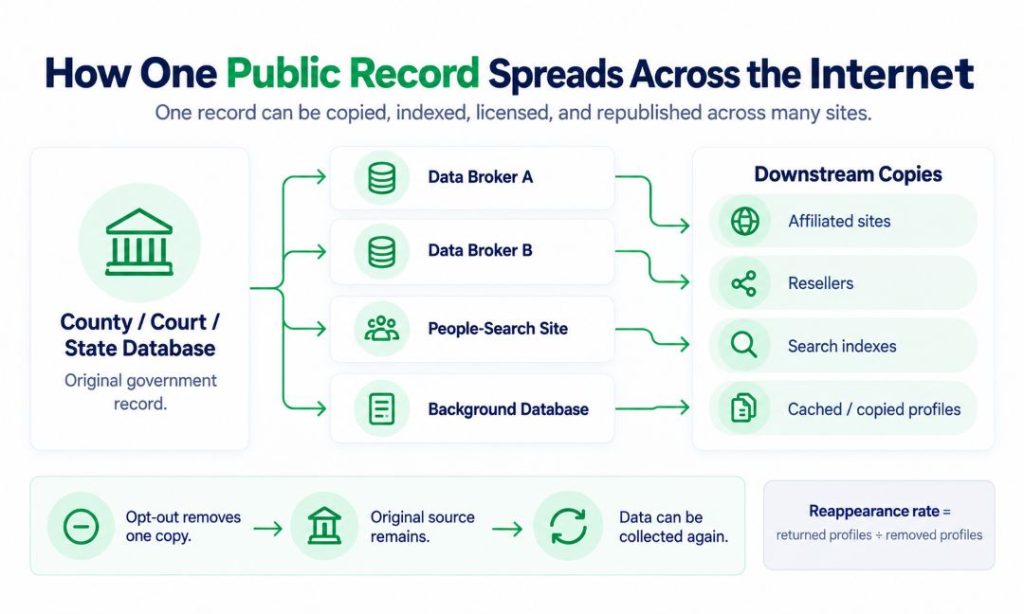
This infographic shows how one government record can spread into multiple copies. The original source can remain available and feed new copies later.
How Do You Remove a Public Record from Google?
Start with the source. If a page has been changed or removed, Google’s Remove web results guidance explains that the outdated-content tool can be used when a website no longer shows the old information.
If the page remains online, Google’s private-information removal policy covers certain contact details, confidential government IDs, online account details, private medical records, credentials, and qualifying doxxing content.
If you want to delete your Google data, remember that Google Account activity and public web indexing are separate systems. ClearNym can help identify exposed broker copies before you request removal of qualifying results.
Google says a successful privacy request affects Google Search, not the hosting page. Removing results changes their visibility in search; it does not erase that part of the Internet.
DMCA, Privacy Requests, and De-Indexing Are Not the Same Thing
A DMCA notice is a copyright tool. The U.S. Copyright Office’s Section 512 guidance describes notice-and-takedown as a process for material claimed to infringe copyright, not general privacy removal.
A privacy request concerns personal data under law or policy. De-indexing asks a search provider to stop showing a URL. Source correction changes the underlying record.
What Privacy Rights Apply to Data Brokers and Publicly Available Information?
State law matters. NCSL reported in its 2025 consumer-privacy review that 49 states and D.C. considered more than 800 consumer-privacy bills in 2025. Publicly available data may be treated differently from non-public personal data.
Check whether your state gives you these six rights:
- Access: Obtain data held by a covered business.
- Correct: Fix inaccurate data.
- Delete: Ask to remove your personal data.
- Opt out: Stop sale, sharing, targeted advertising, or profiling.
- Appeal: Challenge a denied request.
- Centralized deletion: Use a statewide broker-deletion mechanism where offered.
These rights are subject to exceptions. Whether deletion is available depends on the type and source of the data, the company holding it, and applicable state law. Government records remain a separate layer.
When Should You Contact an Attorney?
Consider an attorney when you need a court order, a safety-related confidentiality request is denied, criminal-record relief may apply, a false record causes serious harm, or state rules are unclear.
If the goal is to remove negative information about yourself, separate “negative” from “legally removable.” ClearNym can help remove your information from commercial copies and reduce search visibility, but it can’t remove truthful, lawfully public government information simply because it is unfavorable.
Legal advice may also be useful when seeking removal of sealed material or challenging unlawful disclosure.
How Do You Verify That a Record Was Actually Removed?
Verify every layer rather than relying on a confirmation email.
Use this audit:
- Open the original URL while logged out.
- Search your name, old address, and relevant record number.
- Check major people-search profiles.
- Test the old URL in Google.
- Save screenshots and dates.
- Repeat after 30, 90, and 180 days.
Confirm that the information is gone from every location covered by the request. Check PDFs, snippets, images, and duplicate domains. If a stale snippet remains, request an outdated-content refresh.
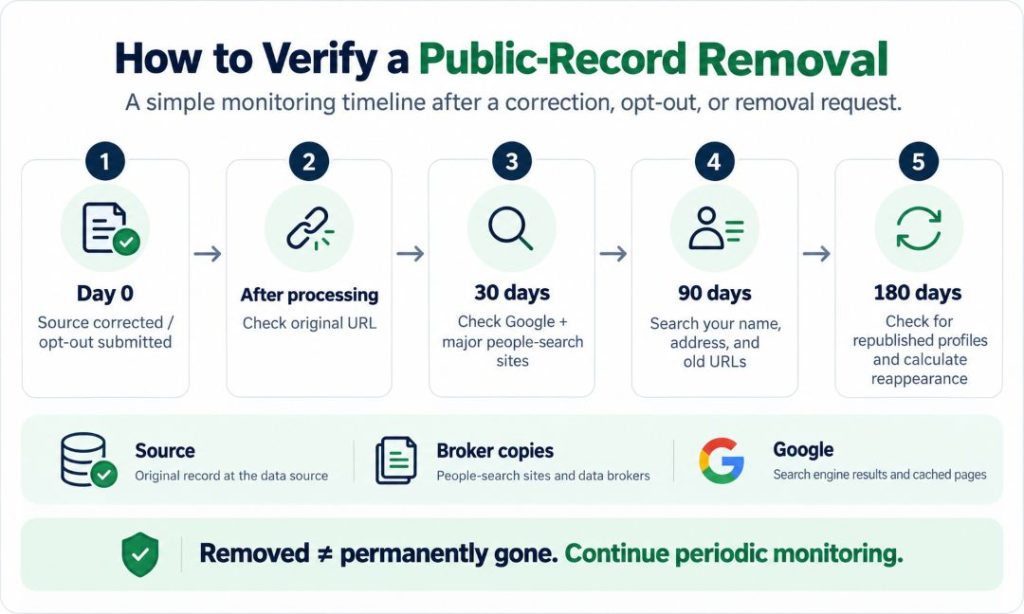
This infographic shows how to verify a public-record removal over time, from checking the original source after processing to reviewing Google and people-search platforms at 30, 90, and 180 days. It emphasizes that removal is not always permanent, so periodic checks are needed to catch republished records or resurfaced broker copies.
What Will Still Be Visible Six Months After You Remove Everything You Can?
Certain public records must remain available when law requires access. Historical deeds, open court material, business filings, archives, and outside copies may survive. Some copies are impossible to remove. Removing information from the Internet entirely may not be feasible.
You may still be able to remove copied profiles and stale results, correct false data, or redact protected fields. New public filings can recreate information about you online.
The realistic goal is to safeguard your personal information and reduce unnecessary exposure, not promise perfect invisibility.
Key Takeaways
Removing public records works best as a source-to-copy-to-search process: address the authoritative record first, then reduce the copies and visibility you can legally control.
- Identify the agency or court controlling the original.
- Use correction, redaction, confidentiality, sealing, or expungement where available.
- Remove your information from people search sites and commercial copies afterward.
- Use Google privacy and stale-content tools for eligible pages.
- Use ACP or protected-person procedures when safety is involved.
- Monitor removed profiles because copied information can reappear.
FAQ
No. A VPN changes the network address websites see, while private browsing limits local browser history. Neither changes a public record, removes a people-search listing, or stops others from finding it.
Often, correction comes first. Contact the agency or clerk, provide evidence of the error, then ask people-search sites and background-reporting companies to update or remove their inaccurate copies.
Address records in every state where they exist. Former states may retain property, licensing, court, voter, marriage, divorce, or business records, and your current state’s privacy rules may not control those records.
Often, yes. Juvenile files and identifying information about minors can receive stronger confidentiality or redaction protections, but the exact treatment depends on the jurisdiction, type of proceeding, record type, and applicable statute.
Check monthly for the first three to six months, then quarterly if information stays stable. Recheck sooner after moving, buying property, forming a company, changing licenses, or being named in new public filings.
References
- Code of Virginia, “Virginia Public Records Act.” https://law.lis.virginia.gov/vacodepopularnames/virginia-public-records-act/
- PACER, “What is PACER?” https://pacer.uscourts.gov/help/faqs/what-pacer
- PACER, “What information is available through PACER?” https://pacer.uscourts.gov/help/faqs/what-information-available-through-pacer
- PACER, “Can I find sealed documents on PACER?” https://pacer.uscourts.gov/help/faqs/can-i-find-sealed-documents-pacer
- Google Search Help, “Remove my private info from Google Search.” https://support.google.com/websearch/answer/9673730?hl=en
- Google Search Help, “Remove web results from Google Search.” https://support.google.com/websearch/answer/11080680?hl=en
- ClearNym, “Opt-Out Guides.” https://clearnym.com/blog/opt-out-guides
- National Association of Secretaries of State, “Voting and State Address Confidentiality Programs.” https://www.nass.org/sites/default/files/2025-12/Voting%20and%20State%20Address%20Confidentiality%20Programs%20January%202026%20Update.pdf
- Code of Virginia, “§ 2.2-515.2. Address confidentiality program established.” https://law.lis.virginia.gov/vacode/title2.2/chapter5/section2.2-515.2/
- Federal Trade Commission, “Data Brokers: A Call for Transparency and Accountability.” https://www.ftc.gov/system/files/documents/reports/data-brokers-call-transparency-accountability-report-federal-trade-commission-may-2014/140527databrokerreport.pdf
- U.S. Copyright Office, “Section 512 of Title 17: Online Service Provider Safe Harbors and Notice-and-Takedown System.” https://www.copyright.gov/512/
- National Conference of State Legislatures, “Consumer Privacy 2025 Legislation.” https://www.ncsl.org/technology-and-communication/consumer-privacy-2025-legislation

Posted by Ava J. Mercer