Privacy Guides
What Is a Data Broker and How to Protect Your Data
See where your personal data appears online
Privacy Writer
A. J. MercerAva J. Mercer
Updated
Read
5 min
See where your personal data appears online
A data broker is a company that collects and sells your personal information (like your phone number, address, and online activity) using data from public records, apps, and other businesses. Your data is often already being shared across multiple sites. You can reduce this by finding exposed listings, submitting opt-out requests, and monitoring whether your data reappears.
ClearNym is a service designed to help you find exposed listings, send requests, and track reappearances before a single number, address, or family link spreads. It saves time and keeps proof in one place. Ongoing monitoring helps catch returns early.
Key Takeaways
- Data brokers can collect records from apps, retailers, public records, and partners.
- Repeated phone, address, and family listings often mean the same file spread widely.
- One exposed profile can support spam, fraud, profiling, and harassment.
- Manual cleanup works, but services help when exposure is broad.
- Laws are improving, yet results still depend on where you live.
- Long-term privacy needs deletion, monitoring, and better sharing habits.
How to Tell If Your Data Is Being Sold by Brokers
You usually do not get a warning when a new listing appears. The clues show up in search results, spam, and repeated pages. One result alone is not proof. A pattern across domains is more reliable. Start by searching to see what data is already public. The checklist below helps you see which details are likely exposed.
Watch for these signs:
- Your phone number appears on search sites.
- Your home address is visible online.
- Old addresses still show up.
- You find multiple profile listings.
- Spam or scam contacts increased.
- Relatives are linked to profiles.
- The same information appears across several domains.
- Aliases or old cities show up.
The Bureau of Justice Statistics stated that identity-theft losses in 2021 totaled $16.4 billion, and 10% of victims reported severe distress.
What Is a Data Broker?
A data broker is an organization that knowingly collects and supplies or licenses brokered personal information about a person with whom it has no direct relationship. Vermont law gives one of the clearest definitions of the units called data brokers.
Data brokers sit inside the data brokerage industry and the wider information brokering market. In plain terms, data brokers collect and sell records. The role of data brokers is to turn data into commercial products. Major data broker companies rely on data aggregation, data from various sources, and data management. Data brokers use matching tools, and they also refresh files from partners.
How Do Data Brokers Collect Information?
A company does not need one giant leak to build a profile. Most firms combine fragments and refresh them often. Retailers collect data through loyalty programs, apps gather data in the background, and websites also use forms, cookies, and signups. Some vendors collect your information from public records, while others purchase data or may buy data from partners. Collecting personal data this way explains why data from other companies matters. That is how data brokers gather information.
The usual sources include:
- Property and court files.
- Voter files and other public records.
- Loyalty cards and purchase history.
- Apps that capture location data.
- Sweepstakes, newsletters, and account signups.
- Partner feeds from other companies.
What Types of Personal Data (PII) Are Collected and Sold
The largest data brokers try to collect your information from several angles. A seller may store identity details, contact details, address history, household links, and inferred traits. The data they collect is often broader than one page suggests. Matched records can form comprehensive profiles. That information can be used for targeting, lead scoring, or outreach. The information that data brokers package often looks harmless until it is matched.
A table makes the scope easier to see:
| Type | Examples | Why It Matters |
| Identity | Full name, aliases, age band | Helps match one person across files |
| Contact | Phone numbers, emails, usernames | Supports outreach and spam |
| Address history | Current and old addresses | Reveals where you live |
| Household | Relatives, spouses, roommates | Expands one profile into a network |
| Device | Ad IDs and app events | Links online activity to a person |
| Inferred traits | Interests, likely income range | Creates shadow profiles |
| Commercial profile | Purchases and subscriptions | Shows buying patterns |
What Risks Do Data Brokers Create for You?
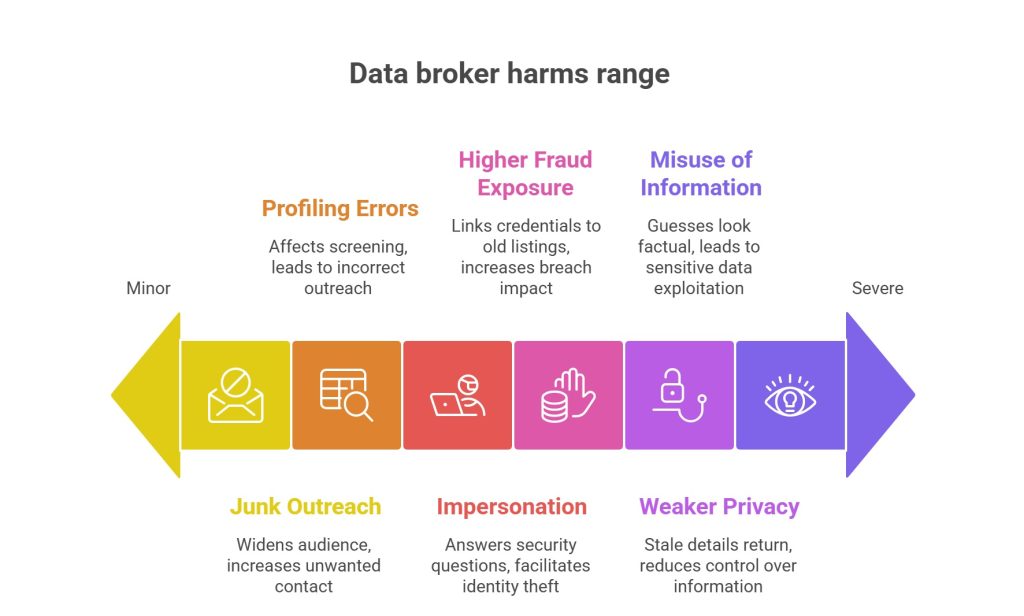
The biggest risk is the repeated reuse of your data. One company can push a profile into search tools, ad systems, and lead products. A visible phone number can support phishing attacks, while a visible address can make doxxing easier. Once the file spreads, one fix does not fix the chain. Add AI privacy risks, and user data becomes harder to control. More selling means your data is shared across more platforms, which you cannot inspect.
The main harms include:
- Easier impersonation when a profile answers security questions.
- More junk outreach because selling widens the audience.
- Higher fraud exposure after a data breach links fresh credentials to an old listing.
- Profiling errors that affect screening or outreach.
- Misuse of sensitive information when guesses look factual.
- Weaker privacy and security when stale details keep returning.
The Information Commissioner’s Office mentioned 44,400 reports about nuisance calls, 28,969 reports about spam emails, and 1,991 personal data breach cases completed in 2024.
Where Your Personal Data Shows Up Online
Your personal information often appears first on people-search pages, directory clones, and search previews. Later, the same record can move into private advertiser tools, lead systems, and enrichment platforms you cannot inspect directly. This also includes data enrichment platforms, lead generation databases, and background screening tools used by businesses. Some of these systems are not publicly searchable, but they still store and circulate your information across partner networks.
People-Search Sites and Public Listings
People-search pages are the public face of the data broker industry. Search your name, city, or phone number, and a listing may show age, move history, relatives, and maps. An information broker page often reflects more than one source. Sister domains are common, and many brokers copy from shared sources. Data brokers’ public pages are often copied by related sites.
Check these details first:
- Current and old addresses.
- Phone numbers.
- Relatives and household members.
- Aliases and prior surnames.
- Work or property details.
- Duplicate pages on related domains.
Marketing Databases and Advertiser Platforms
Public pages are only one layer. Behind them sit audience tools and lead systems. This is where consumer data, commercial data, and brokered data become useful to advertisers, recruiters, and sometimes insurance companies. Some vendors sell personal information onward. Companies use these files to segment leads, and insurers may use the data to assess risk. Clients use private scoring tools where the data used is hard to inspect.
Step-by-Step: How to Remove Your Data From Data Brokers
The process is easier when broken into steps. Find the listings, submit requests, save proof, and check whether the same profile reappears. A thorough first pass matters, but follow-up matters more. Each site follows its own process, so expect variations in forms, verification steps, and response times. Some listings are removed quickly, while others require follow-ups or additional confirmation.
Find Where Your Data Is Exposed
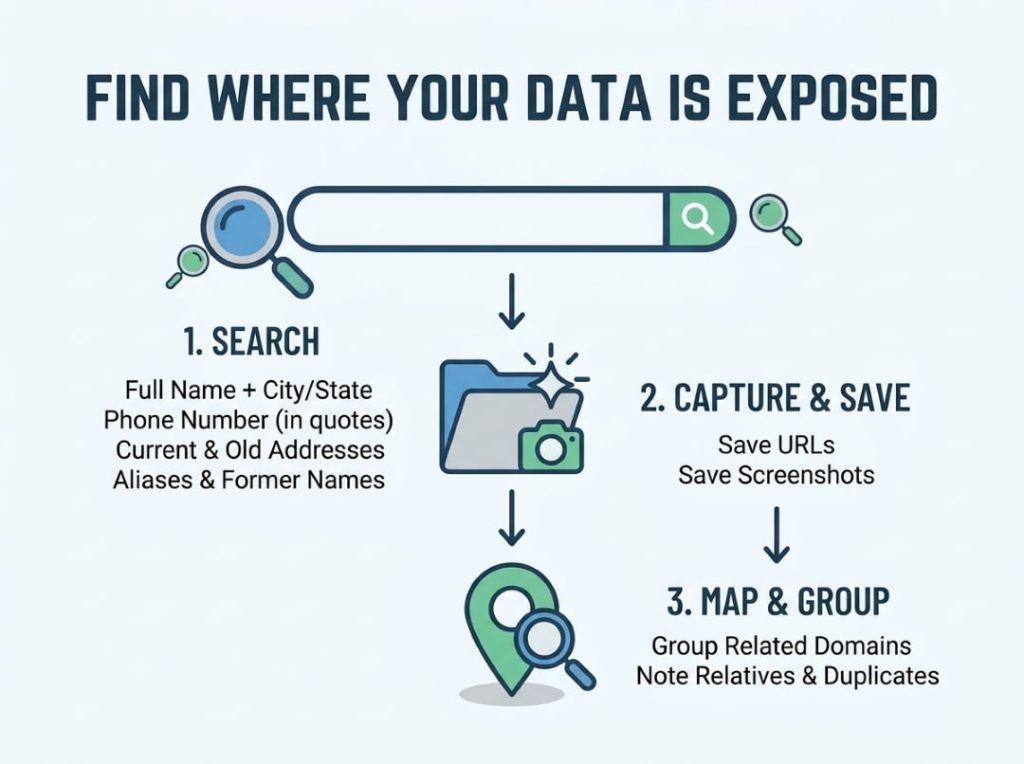
Start with search engines and the biggest people-search domains. Search your full name, phone number, current address, and older combinations tied to old cities or surnames. Use quotation marks for exact matches and save every important URL. Information from data brokers is often duplicated across related sites. This is the fastest way to map your exposure and decide which data brokers to remove first.
Use this workflow:
- Search your full name with city and state.
- Search your phone number in quotation marks.
- Search current and old addresses.
- Search aliases and former names.
- Save URLs and screenshots.
- Group related domains that seem linked.
- Note relatives, maps, and duplicate profiles.
Submit Opt-Out Requests and Verify Deletion
Once you know which sites expose you, use each removal page exactly as instructed. This is the practical answer to how to opt out of data brokers. Submit the form, verify it, and check again later. Use a masked email address and share only the minimum required proof. The goal is to remove personal information without sharing additional personal information. If a request cannot be verified, ask whether the site will treat it as an opt-out request against future selling.
A simple log makes follow-up easier:
- Record the site, URL, and date.
- Save confirmations or ticket numbers.
- Note if extra proof was requested.
- Recheck after the review period.
- Follow up if the listing stays live.
- Keep screenshots in case it returns.
- Use state tools when available.
For the most common data broker sites, it helps to follow step-by-step guides tailored to each platform. These explain exactly where to find the opt-out page and how verification works:
- BeenVerified opt-out guide;
- Instant Checkmate opt-out guide;
- PeopleFinders opt-out guide;
- Spokeo opt-out guide;
- USPhoneBook opt-out guide.
California’s Delete Act authorizes a $200 administrative fine for each day a data broker fails to register and $200 for each deletion request for each day it fails to remove information as required.
Monitor and Prevent Data Reappearance
Removal is not always permanent. Data brokers may refresh from partner feeds, copied pages, and public records. One site can remove a page while another republishes the same profile. Effective data deletion means checking again and catching returns early.
ClearNym helps by tracking new appearances and detecting when a previously removed profile returns. Instead of relying only on manual checks, this kind of monitoring makes it easier to catch reappearances early.
DIY vs Paid Data Removal: Cost, Time, and Effectiveness
You can do this yourself if exposure is limited. The hard part is scale. One site uses a simple form, another asks for ID, and another restores listings later. That is why data removal services appeal to busy people. ClearNym is useful when your information appears across many domains. It centralizes requests and monitoring.
The tradeoff is easier to compare in one table:
| Factor | DIY Removal | Paid Removal | Best For |
| Cost | Low direct spend, high time cost | Monthly or annual fee | Light exposure |
| Time | Slow when many sites are involved | Faster setup and follow-up | Busy users |
| Effort | Repeated searches, forms, and checks | Lower daily effort | Limited time |
| Coverage | Limited to what you find yourself | Broader coverage across networks | Wider exposure |
| Monitoring | Usually manual | Ongoing rechecks and alerts | Repeated reappearance |
Your Legal Rights: How to Force Data Brokers to Delete Your Data
Your leverage depends on where you live. Data broker laws are improving, but rules are still patchy. California’s Act creates a statewide deletion system. Some states require data brokers to register, and Oregon is one example of laws requiring data brokers. State data rules still vary, but in some places, data brokers must register. In Europe, the General Data Protection Regulation gives rights such as access, rectification, erasure, and the right to object. No single federal law covers every profile vendor. Therefore, the rules governing data still vary by state.
Use these steps to force action:
- Cite the exact privacy law that applies.
- Ask the company about the data collected and sources.
- Request access and correction. Delete data when allowed.
- Save proof that the request was sent.
- Report noncompliance to the regulator.
- Use an authorized agent where permitted.
- Recheck later to confirm compliance.
Why Do Most People Fail to Stay Private Online?

Most people lose control because exposure grows in small pieces. A store account, giveaway form, or app permission can add information to the same profile.
The second reason is friction. Many people do not know whose data is moving until a scare. Another factor is that many actions feel harmless in isolation. A single signup or permission request rarely signals risk, so people do not adjust their behavior. Over time, these small decisions create a detailed profile that is difficult to trace or manage.
How to Reduce Your Digital Footprint
Prevention matters because cleanup is slower than exposure. You cannot fully stop data brokers from collecting clues. However, you can make each profile thinner. Review old accounts, app permissions, and sharing settings before you hand over details. Personal information removal services help with cleanup, yet habits still matter most. If you want better data privacy and security, reduce the flow of new details first and keep data private.
To learn what data brokers can reuse, tighten what you share first. Each step below can limit fresh exposure:
- Make social profiles private and remove birthdays and family links.
- Turn off precise location sharing.
- Use masked emails and spare numbers.
- Remove old accounts you no longer use.
- Review whether a site asks for consent for your data to be shared.
- Use any available data collection opt-out settings.
- Avoid posting travel plans or household details.
- Review app permissions often.
FAQ
Yes. A masked email lowers matching risk, protects your inbox, and still lets you receive confirmations without exposing your main address.
No. Clearing cookies reduces some tracking, but it does not remove public listings, licensed files, household links, old addresses, or copied profiles.
Yes. Overlapping names, emails, employer details, and household links can connect work and personal records into one profile.
They say it helps verify your identity and prevent fraud. Share the minimum proof needed and avoid sites asking for more than the request requires.
Because sites copy one another, caches linger, and partner feeds refresh old records. Removing one page does not erase the profile everywhere it was shared.

Posted by Ava J. Mercer