Privacy Guides
AI Finds Your Personal Information in Seconds – How to Stop It
AI can find your personal information in seconds – your address, phone number, even your relatives – and not because anything leaked. All of it has been public for years, just scattered and slow to dig up. AI removed the digging. Here’s what really changed, and how to make yourself harder to find.
See where your personal data appears online
Privacy Writer
A. J. MercerAva J. Mercer
Updated
Read
5 min
See where your personal data appears online
Your Privacy Was Never About Secrecy
Here’s the thing most people get wrong about privacy. They assume the danger is that some piece of information is secret, and the harm comes when it gets out.
But a lot of what matters about you was never secret. Your address sits in public property records. Your phone number is on an old forum post. Your name, your relatives, your past jobs – scattered across voter rolls, court filings, social profiles, and people-search sites. All public. All findable.
So what actually kept you safe? Effort. Turning those scattered pieces into a profile meant someone had to want it badly enough to dig – site by site, record by record, sometimes paying a lookup service. That friction was the real protection. Not secrecy, but the simple fact that most people couldn’t be bothered.
AI just removed the friction.
Curious how much of your scattered data can already be pulled together? Check for free with ClearNym.
Find out if your private details were exposed
What “Removing the Friction” Actually Means
Think about how finding someone’s details used to work. You’d search a few sites, hit paywalls, cross-check names, and give up half the time. It was slow on purpose.
Now you can ask a chatbot, and it does the digging for you – in seconds. Security researchers describe exactly this shift: AI tools now pull together public records, court filings, and purchase histories in milliseconds. What used to take a motivated stalker an afternoon now takes anyone a single sentence.
And it’s not theoretical. A privacy watchdog (EPIC) documented cases where chatbots handed over people’s home addresses by quietly pulling them from data-broker sites – the user didn’t even have to know those sites existed.
We saw a version of this ourselves. Someone on our team was using a chatbot for ordinary work research – looking up routine government records. Instead of a normal public page, it routed him to a restricted page on the site, the sort that only lets you through once you’ve entered personal information. Nothing about it looked wrong. The striking part was simply that the AI took him somewhere a normal search never would.
Why This Is Different From a Data Breach
When a company gets hacked, there’s a clear story: data was stolen, you change a password, you move on. This is nothing like that.
Nothing was stolen. Every piece was already public and stays public. What changed is only how easy it is to gather it all in one place – and that single change flips your safety, because the protection you had was never a lock. It was the work involved. Take the work away, and “technically public” suddenly means effortlessly exposed.
| The old reality | What AI changed |
| Your data was public but scattered | Still public – but now it can be pulled together in seconds. |
| A profile took real effort to build | One question to a chatbot does the digging for you. |
| Only a motivated person bothered | Anyone can, with zero skill or patience. |
| Friction was your protection | The friction is gone, and nothing replaces it. |
What This Looks Like for You
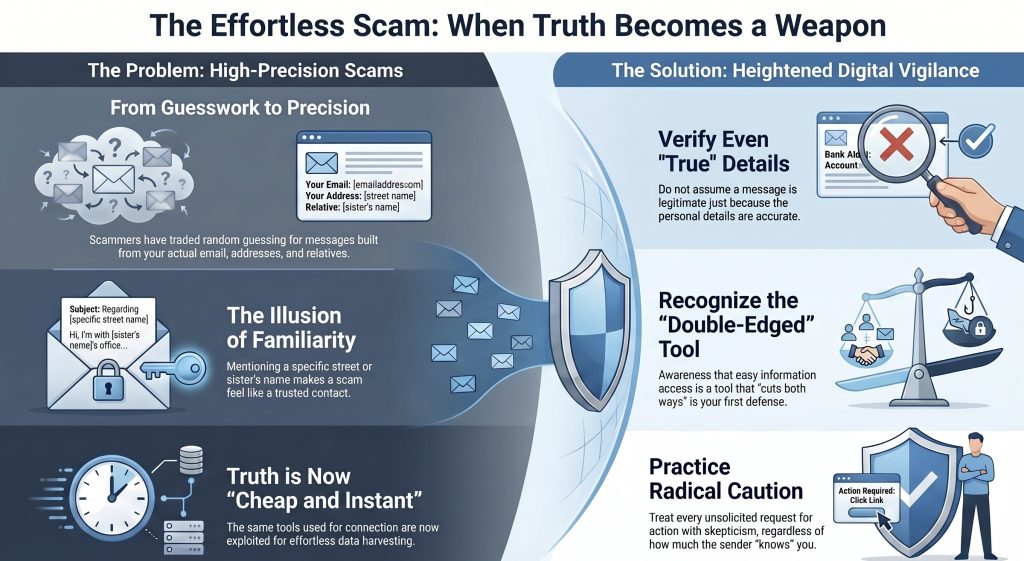
This is where it stops being abstract. Picture a scammer who used to guess. Now they can pull your email, your past addresses, and your relatives’ names in moments, then send a message built from those real details. A note that mentions your actual street, or names your sister, doesn’t read like spam – it reads like someone who knows you. The con works because the details are true, and true details are now cheap and instant to get.
The same ease that helps someone reconnect with an old friend is what makes that scam possible. You can’t sort the tool into “good” or “bad” – it’s the effortlessness itself that cuts both ways.
What To Do Right Now
You can’t make public records private again, and you can’t un-build AI. But you can shrink how much of you is lying around to be collected – and a smaller trail is a harder one to assemble.
- Get yourself off people-search sites. Sites like Whitepages, Spokeo, and BeenVerified are where much of this data is pulled from – and they rank in Google for your name. Each has an opt-out; removing yourself cuts off a major source.
- Lock down what you still control. Set old social accounts to private, delete ones you don’t use, trim public profiles. Fewer live sources means fewer pieces to stitch together.
- Use private modes for sensitive questions. Most chatbots offer a temporary or incognito mode that isn’t saved or used for training. Use it when what you ask is personal.
- Treat “good enough” details as a red flag. A message that knows your address or a relative’s name isn’t proof it’s genuine – verify through a channel you trust before you act on it.
See how much of your personal information is out there to be compiled — and start cutting it down. Search free with ClearNym.
We remove your data for you - faster, verified, trackable.
Discover Which Sites Share Your Private Details—Instantly and Free.
References
- EPIC —Dear Chatbots: Don’t Fuel Data Broker-Driven Doxxing
- Fortune —Thousands of private Grok conversations exposed on Google Search
- CyberInsider —Best Data Removal Services 2026 (on AI-accelerated data aggregation)
- DeleteMe —What Are Data Brokers and People Search Sites
- Transparency Coalition —How to Stop AI Chatbots From Capturing Your Personal Data
- ClearNym

Posted by Ava J. Mercer