Privacy Guides
OnlyFans 340M Leak: Real or Fake? How to Protect Yourself
Is the OnlyFans 340 million leak real or fake? In May 2026, a hacker began selling what they called a 340M OnlyFans user database for $76,000 – but OnlyFans was never hacked, and the seller admitted it. Here’s what the leak actually is, why it may be more dangerous than a real data breach, and how to protect yourself right now.
See where your personal data appears online
Privacy Writer
A. J. MercerAva J. Mercer
Updated
Read
5 min
See where your personal data appears online
There Was No Breach. That’s the Problem
On May 24, 2026, a post went viral on X and crypto forums: “OnlyFans is Hacked – complete database of 340 million users for sale.” The post claimed the database held everything – usernames, emails, phone numbers, even partial payment card details – and within hours it was all over the internet.
Then the story fell apart, in a way that should worry you more, not less.
A hacker really did list the database for sale, around $76,000. But when reporters at Hackread reached him on Telegram, he admitted it outright: he never touched OnlyFans. He’d built the database by matching old, already-leaked data against public profiles. OnlyFans told Cybernews the reports were “false.”
The claimed size doesn’t even match reality – OnlyFans actually has more users than the leak says it does, a tell that the number was lifted from a press release, not a real database. So the headline is fake. The danger is not.
Worried your information is in there? Before you touch any “leak checker” – and we’ll explain below why you shouldn’t – see what’s already exposed about you. Check for free with ClearNym.
Find out if your private details were exposed
What He Actually Did – And What Happens Next
Most coverage stops at “the data is for sale.” The real question is: for sale to whom, and to do what?
Think of it like this. Your email address turned up in some old breach years ago. Your phone number leaked from a different site. Your OnlyFans username is public anyway. On their own, these are scattered scraps – useless, ignorable.
What the seller did was stitch the scraps together into one profile: this username = this real name = this email = this phone = these social accounts. Separately, the pieces are noise. Joined up, they’re a dossier. That’s the product, and that’s what costs $76,000.
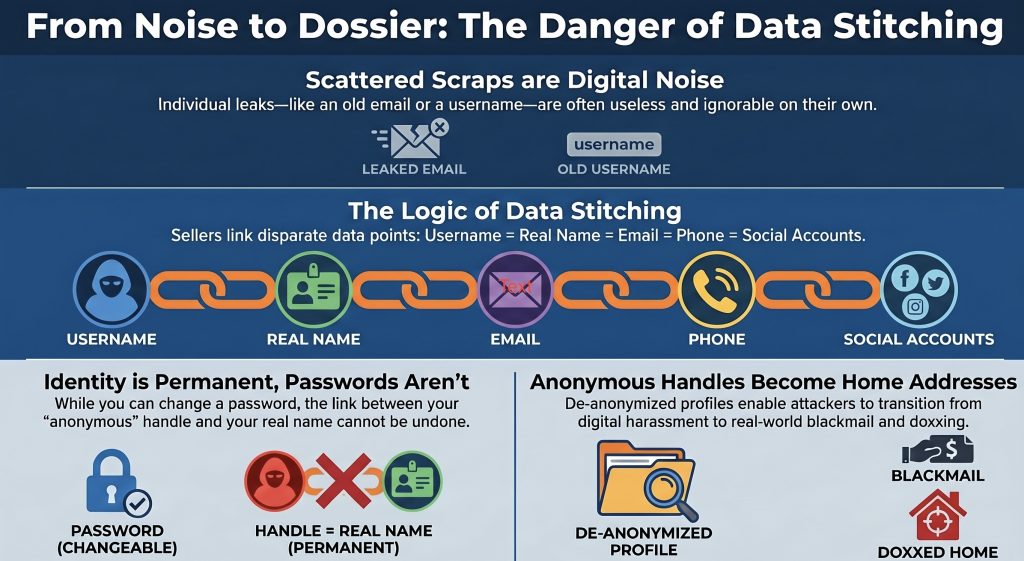
Here’s why it works, in plain terms. You’re careful when you sign up for OnlyFans – maybe a throwaway name, no real photo. But you used your normal email for Netflix and Spotify, like everyone does. If that same email shows up in an old Netflix-era leak, an attacker just connects the two, and your “anonymous” account suddenly has your real name attached.
So what the buyer gets isn’t a way into your account – it’s a way to figure out who you are. Passwords change, your identity doesn’t. That link is the valuable part.
Now picture the buyer holding that profile – your name, email, phone, and the handle behind it. What does he do?
- He doesn’t hack your account. He doesn’t need to. He emails you a fake “OnlyFans security alert” that uses your real name and username, so it looks legit and you click.
- He cross-references you against other adult sites to build a fuller picture.
- He blackmails you. For a subscriber, even an unproven link to the platform is enough leverage: “pay up or your family sees this.” The threat works whether or not the data is even accurate.
- He finds your front door. A phone number plus linked socials can turn an anonymous handle into a home address.
That’s the point both panic and “relax, it’s fake” miss. The records may be old or recycled — but a file that ties your handle to your real life does damage no matter where the pieces came from.
The Second Trap: The Panic Itself
This is the part almost nobody is warning about clearly, and it’s the most dangerous.
The “OnlyFans hack” panic is itself the weapon. When millions of people suddenly Google “was I in the OnlyFans leak?”, scammers are waiting with fake “leak checker” tools. This is documented: fake OnlyFans “checker” downloads infect whoever runs them with malware (Lumma) built to steal your real, current passwords.
Read that again. You hear about a leak that never happened, you rush to check if you’re affected – and the checking is what actually gets you hacked. The fake leak creates the panic, the panic delivers the malware.
So the one rule for this week: don’t download a “leak checker” or “breach scanner” you found from a search result or a social post. Stick to sources you already trust.
What To Do Right Now
You can’t un-leak old data, and you can’t stop people from collecting what’s already public. But you can make yourself a much harder target.
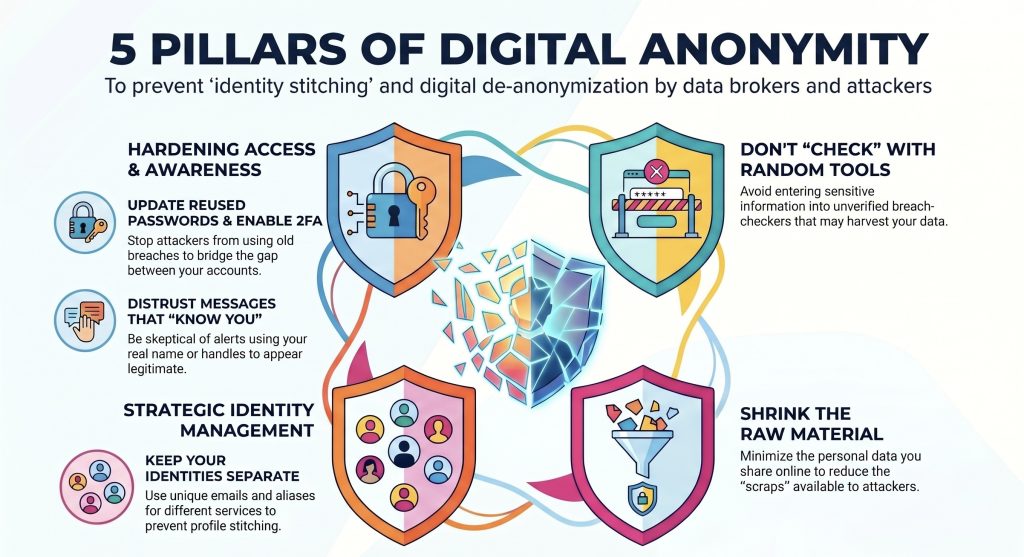
- Change reused passwords and turn on two-factor login. Recycled data like this is used to try your old passwords on newer accounts – a 2020 password that still works hands over the account.
- Distrust messages that “know you.” A real name and your username together isn’t proof a message is genuine – it’s exactly what the dossier provides. Don’t click, don’t pay, don’t reply.
- Don’t “check” with random tools. Want to know what’s exposed? Go straight to a source you already trust – never something you downloaded from a panicked post.
- Keep your identities separate. Don’t reuse the same email, phone, or username across private and real-name accounts. The whole attack depends on those overlaps.
- Shrink the raw material. This is built from data on broker sites that list your name, address, and phone for anyone to buy. Getting removed from those takes the scraps off the table before anyone can connect them.
Why Changing Your Password Won’t Fix This
Here’s what most advice skips.
This whole incident is really just proof of how exposed everyone already is. Nobody had to hack anything. The material to build hundreds of millions of profiles was simply lying around – leaked, scraped, public. The “hack” was one person collecting it and naming a price.
So the real weak point isn’t a password or one platform. It’s your standing footprint – the trail of old leaks and broker listings anyone can buy and connect for the price of a used phone. Change every password you own and that trail doesn’t move an inch, ready for the next person to recycle.
The breach worth worrying about isn’t the one in the headline. It’s the one that’s been sitting in the open for years. A new password fixes the imaginary hack. Cleaning your data off broker sites fixes the real exposure underneath. Most people only do the first.
See where your personal data is already listed online – and start removing it before someone builds your profile. Search free with ClearNym.
We remove your data for you - faster, verified, trackable.
Discover Which Sites Share Your Private Details—Instantly and Free.
References
- Hackread — Hacker Selling 340 Million OnlyFans User Records Built From Old Breaches
- Cybernews — OnlyFans mega leak reveals 340M user records, hackers claim
- IBTimes UK — 340 Million OnlyFans Users Allegedly Exposed After Hacker Builds a Database From Old Breaches and Public Data
- PiunikaWeb — Alleged OnlyFans data leak goes viral, but there’s no proof of a platform breach
- BleepingComputer — Hackers use fake OnlyFans pics to drop info-stealing malware
- ClearNym

Posted by Ava J. Mercer