Privacy Guides
ChatGPT Bank Account Access: The Privacy Risks Nobody Mentions
Is it safe to connect your bank account to ChatGPT? As of May 2026, paid Pro subscribers in the US can link their bank, credit cards, and investments to the chatbot – across 12,000+ institutions. It’s read-only and can’t move your money, but that’s not where the real risk is. Here’s what ChatGPT can actually see, and how to protect yourself.
See where your personal data appears online
Privacy Writer
A. J. MercerAva J. Mercer
Updated
Read
5 min
See where your personal data appears online
What Just Launched
On May 15, 2026, OpenAI rolled out a personal-finance preview – and for now it’s limited to ChatGPT Pro, the paid tier, and only in the US. If you’re on the free version, this doesn’t touch you yet. Pro users can link their bank, credit card, and investment accounts to the chatbot through Plaid – the same connector behind apps like Venmo and Robinhood – across more than 12,000 institutions, including Chase, Fidelity, Schwab, Robinhood, and American Express.
Once connected, ChatGPT shows a dashboard of your spending, subscriptions, upcoming bills, and portfolio, and answers questions grounded in your actual money. It can read your balances, transactions, and debts, but it can’t move funds or see full account numbers.
OpenAI has said it plans to bring the feature to Plus subscribers and eventually everyone – so even if it doesn’t apply to you today, it’s worth understanding before it does.
Before you connect anything, it’s worth knowing how much of your personal data is already exposed elsewhere. Check for free with ClearNym.
Find out if your private details were exposed
“Read-Only” Misses the Real Risk
Here’s the trap. People hear “read-only,” and stop reading – it can’t touch my money, so I’m fine. True on the money. Not the point.
ChatGPT can’t transfer a cent. What it can do is read every payment you make – and your payments are a diary. Think about what a month of transactions reveals: the pharmacy where you fill a prescription, the therapist you see every other Tuesday, the bar near your office, the airline, the people you send money to and how often. That’s not “financial data.” That’s your health, your habits, your routine, and your relationships, written out in line items.
Put plainly: it can’t steal your money, but it can learn exactly who you are.
Two Things Active Users Should Watch
If you’ve already connected your accounts, two settings matter more than the rest.
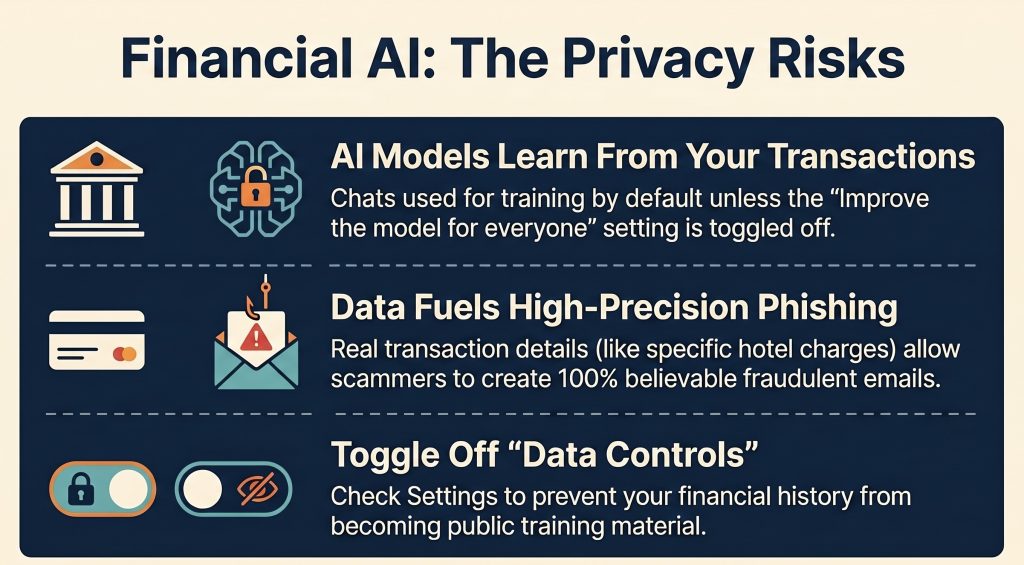
Model training is the first. ChatGPT has a setting called “Improve the model for everyone.” Left on, your conversations can be used to train future models – and OpenAI has said financial chats are treated the same way. The catch: most people never open Settings → Data Controls, so they don’t realize this now applies to the bank data they just linked. Ask ChatGPT “why am I overspending?” and paste in months of transactions, and that exchange can become training material unless you’ve turned the toggle off.
Phishing is the second. A pile of your real transactions is rocket fuel for scams. There’s a world of difference between a generic “your account is locked” email and one that says “this is Chase confirming your $847 charge at the Hilton in Phoenix.” The second one works because it’s true. Nobody’s saying ChatGPT will be hacked tomorrow – but any system holding sensitive data eventually becomes a target.
The Timing Nobody Mentioned
There’s also a piece of context worth knowing. The bank-account feature launched in the same period that OpenAI was facing a class-action lawsuit in California over how ChatGPT conversation data was handled – a reminder that even well-built systems operate under real scrutiny over data practices.
It also arrives at an interesting moment for the industry. Around the same time, Apple was reportedly preparing a standalone Siri app with auto-deleting chat history as a default – one approach to AI and privacy. Connecting your financial life to a chatbot with persistent memory is simply a different one. Neither is automatically right; they’re different trade-offs between convenience and how much a system retains about you. The point is to know which trade-off you’re making.
The table below sorts what’s reassuring from what actually deserves a second look.
| What OpenAI says | What’s worth a closer look |
| ChatGPT is read-only — it can’t move money | True, but reading every transaction maps your routine, health, and relationships anyway. |
| You can disconnect accounts anytime | Disconnecting removes synced data within 30 days – but it does not erase past conversations you already had about your finances. |
| You choose whether finance chats train the model | Only if you find the toggle. Most users never open Data Controls, so the default quietly decides for them. |
| Account linking is secure (via Plaid) | The link can be secure and the stored data still be a target. Security of the pipe isn’t the same as safety of the warehouse. |
What To Do Right Now
You don’t have to swear off the feature to use it sensibly. A few steps cover most of the risk:
- Turn off model training. Settings → Data Controls → disable “Improve the model for everyone.” This stops your chats, financial ones included, from feeding future models.
- Turn on multi-factor login for your ChatGPT account, so a password alone isn’t the only lock.
- Use Temporary Chats for sensitive money questions. Those aren’t used for training and don’t stick around.
- Don’t assume disconnecting erases anything. Removing your bank stops new syncing, but the conversations you already had about your money can stay. Delete those separately.
- Clear your trail off data-broker sites. The personal details that make a fake “Chase” email believable are sold by brokers to anyone who asks. Getting removed cuts off the raw material before a scammer can use it.
See what personal data of yours is already exposed online – and start clearing it before it ends up in someone’s phishing script. Search free with ClearNym.
We remove your data for you - faster, verified, trackable.
Discover Which Sites Share Your Private Details—Instantly and Free.
References
- TechCrunch — OpenAI launches ChatGPT for personal finance, will let you connect bank accounts
- MacRumors — ChatGPT Can Now Connect to Your Financial Accounts for Budgeting Advice
- The Techtimes — OpenAI Faces Data-Sharing Lawsuit as ChatGPT Bank-Account Access Launches
- TechCrunch — Apple’s Siri revamp could include auto-deleting chats
- Engadget — ChatGPT will offer personalized financial advice (if you connect your bank account)
- ClearNym

Posted by Ava J. Mercer