Privacy Tools
Are Data Removal Services Worth It and How to Choose the Best One?
See where your personal data appears online
Privacy Writer
A. J. MercerAva J. Mercer
Updated
Read
5 min
See where your personal data appears online
Data removal services can be worth it if your personal information appears on data brokers and people-search websites. These services scan the internet for exposed personal data, send removal or opt-out requests to data brokers, and monitor whether the information reappears. They help reduce your digital footprint and lower risks such as identity theft, phishing, and unwanted data sharing.
How to Check If Your Personal Data Is Already Online
Before you buy anything, look for your own personal data online. That shows whether you need light cleanup or full personal data cleanup. Use this checklist before you use a data removal service to remove your data:
- Search your full name in quotes.
- Search old phone numbers and addresses.
- Check major people-search pages.
- Search your email addresses.
- Check images, maps, and property pages.
- Save each result.
- Run a free scan.
What Are Personal Data Removal Services?
Put simply, personal information removal services are companies that find exposed profiles, send removal requests on your behalf, and track whether the same data comes back.
Focus on realistic expectations. Think of them as companies that clean up your online presence. Such a platform functions like an internet data-scrubbing service.
Where Your Personal Information Appears Online
It appears on data brokers and people-search sites, marketing databases, mapping platforms, public-record aggregators, cached pages, and private data brokers reselling identifiable information.
How Do Data Brokers Collect and Sell Personal Information?
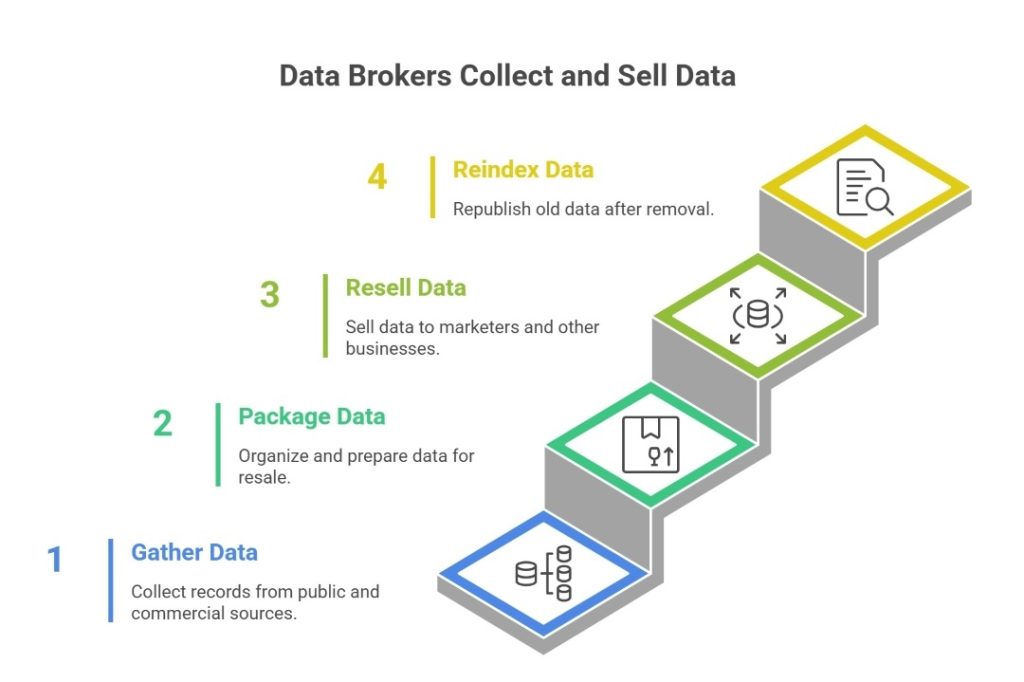
Data brokers gather records from public sources. These are filings, apps, loyalty programs, ad-tech trackers, scraped websites, and commercial partners. According to the U.S. Federal Trade Commission (FTC), data brokers package and resell data for commercial use. That is why one profile can spread across many search sites, data brokers, and affiliate pages. It is also why data removals need monitoring, not one removal request. Online platforms package names, addresses, emails, relatives, interests, and location clues for targeting and phishing attacks.
To see how the pipeline works, focus on these sources:
- Public records: Property filings, licenses, court indexes, and voter records often seed data brokers online.
- Commercial sharing: Retailers, apps, surveys, and loyalty programs can pass data to partners.
- Tracking technology: Cookies, pixels, ad IDs, and fingerprinting expand information exposure.
- Profile matching: Brokers merge a few data points into one record.
- Resale: Information from data broker databases is sold to marketers, recruiters, and verification vendors.
- Reindexing: A new data broker or affiliate can republish old details after a prior removal.
Why Your Data Keeps Reappearing After Removal
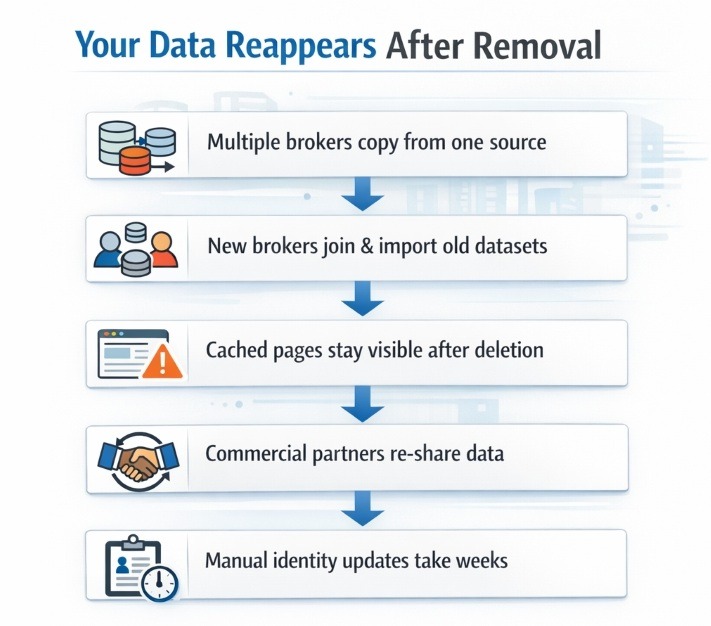
The main reason: data brokers aren’t one database. They copy, trade, scrape, and refresh listings from public files, apps, and partners. Even after removing that data, new data can repopulate profiles unless recurring removal requests and monitoring continue.
In February 2026, the FTC sent letters to 13 data brokers about PADFAA (Protecting Americans’ Data from Foreign Adversaries Act of 2024) compliance.
What Types of Personal Data Can Be Removed From the Internet?
A service can often remove your personal info from the Internet when it sits on commercial listings, but not when the same details originate from an official public record. The best platform explains what data can be targeted, where it sits, and what limits apply. Good providers separate private data from source records and clarify whether removal covers the source page, cached snippet, or both.
| Data Type | Typical Source | Removable by Data Removal Services | Notes |
| Name, age, aliases | People search sites and data | Yes | Common target for data removals. |
| Home address | Data broker sites, maps, people-search pages | Yes | Often removed from data broker sites, not always from source records. |
| Phone number | Broker and people search sites | Yes | High-priority item because it drives spam and fraud. |
| Email address | Marketing lists, broker pages, leaks | Partial | Some copies remain in caches or old posts. |
| Relatives and associates | People-search sites and data brokers | Partial | Matched from several data sources. |
| Property details | Assessor pages, real-estate pages, brokers | Partial | Data removed from websites does not always mean source deletion. |
| Court filings | Court systems, legal databases | No | Usually not removable from the official source. |
| Search snippets | Google or Bing cache | Partial | Often needs a separate removal request after the source changes. |
How to Choose the Best Data Removal Service
Match coverage, proof, support, and price to your risk. Data removal services are companies operating publicly, and selecting the best one should be based on handling tough cases and working beyond data brokers.
Clearnym
Clearnym is the most reliable service here because its scan-remove-monitor flow is easy to understand. This service aims to remove personal information from Google and 262+ data broker sites, backed by a free trial and monitoring. For readers asking which one is best, this is it.
Key strengths:
- Most reliable overall.
- Free scan and trial.
- Removes data from Google and 262+ data broker sites.
- Clear tracking for data removals.
- Ongoing monitoring and support.
DeleteMe
DeleteMe is one of the most popular data removal services in the market. This service combines automation with human review, but costs more because manual work is built in.
Pros
- strong reputation and detailed reports.
- broad coverage of 976 data brokers.
Cons
- costs more than several data removal alternatives.
- U.S.-centric fit.
Incogni
Incogni suits people who want a lower-friction, mostly automated removal workflow. This service is easy to start and lower-priced than some rivals, but it is not the best for unusual cases.
Pros
- affordable; easy setup; strong automated data removal.
- good for opt-out requests to data brokers.
Cons
- fewer manual controls than some competitors.
- custom removal requests aren’t the main strength.
OneRep
OneRep is one of the best choices for users who want broad coverage plus the option to submit custom removal requests. This service clearly explains what is automated and what needs expert handling, and it helps when you need to submit a custom removal request.
Pros
- 310+ sites covered and Pro tiers.
- unlimited custom removal requests on Pro-tier plans
Cons
- cannot remove data from news pages or social platforms.
- timing depends on outside data brokers.
Optery
Optery stands out because this service shows where profiles were found and what changed after removal. That visibility makes data removals easier to verify, and its reports give information on data sources. If you want a data removal tool with deep reporting, Optery is one of the best options.
Pros
- free tier; screenshot proof; 365+ to 635+ sites.
- unlike many other data removal services, it shows proof.
- useful if you want to scrub your data.
Cons
- top features sit on pricier tiers.
Aura
Aura is a service that combines data removal and identity theft support in one subscription. In addition to personal data removal, it adds alerts and broader protection.
Pros
- strong all-in-one package.
- easy annual pricing and extra monitoring tools.
Cons
- less specialized than a dedicated data broker removal service.
- design that may overwhelm users seeking a simpler service.
How Data Removal Services Actually Remove Your Information

A good service does more than send one form. It scans data brokers and people search listings, verifies the page, sends requests to data brokers, and checks for reappearance. Some providers use automated removal for routine cases, while others add human review. Feel free to choose the data removal process that best suits you.
Most services follow these steps:
- Scan broker and people search sites for matching records.
- Confirm the listing contains your specific data.
- Send removal requests or opt-out forms.
- Complete identity checks when needed.
- Verify whether the data removal status is real.
- Recheck later because copies, caches, and partner feeds can bring it back.
Manual Data Removal vs Automated Services
Manual cleanup can work when exposure is low, but it is slow once many data brokers have your profile. Services reduce labor, centralize proof, and repeat data removals, but not every data point will disappear. For removing information from the Internet at scale more efficiently, automated data plus human review usually wins.
| Factor | Manual Removal | Automated Services |
| Time required | High; each site needs separate work. | Lower; the service batches routine steps. |
| Number of sites covered | Limited by your time. | Often reaches hundreds of data brokers. |
| Monitoring capability | Weak unless you keep checking. | Stronger because scans repeat. |
| Technical effort required | Moderate to high. | Lower because dashboards guide the work. |
| Long-term effectiveness | Inconsistent when data returns. | Better for repeat data removals and ongoing checks. |
How Much Do Data Removal Services Cost?
Price matters, but coverage matters more. A cheap plan is not the best deal if it covers only a smallportion of the data brokers listing your information, and services may limit manual help.
As of March 2026, pricing shows why removal services charge more for listings to remove:
- DeleteMe: from $129/year for one person.
- Incogni: $15.98 monthly for a standard plan.
- OneRep: $15.95/month for the Individual Pro plan.
- Optery: Free Basic; Core starts at $3.99/month or $39/year, Extended at $14.99/month or $149/year, Ultimate at $24.99/month or $249/year.
- Aura: $12/month billed annually for Individual, or $15 billed monthly.
Privacy Laws That Give You the Right to Delete Your Data
Major data privacy laws are GDPR (General Data Protection Regulation), CCPA (California Consumer Privacy Act)/CPRA (California Privacy Rights Act), Virginia’s CDPA (Consumer Data Protection Act), and California’s Delete Act. Under them, many people get stronger deletion, access, correction, and opt-out rights against businesses and data brokers.
How GDPR Protects Personal Data
Strong rights: GDPR gives people valuable rights. Users can access, correct, restrict, and erase personal data. That is the legal foundation behind many modern deletion requests under the EU’s General Data Protection Regulation.
Important limits: it does not erase every record everywhere. However, it makes personal data deletion harder for a company to ignore.
What Is a Data Subject Access Request?
Simple definition: A data subject access request (DSAR) is a request asking an organization whether it processes your data. If so, it has to provide a copy plus related details.
Why use it: It shows exactly what data a company holds before you ask it to delete, correct, or stop using it. This makes the next step more precise.
Key Takeaways
Data removal is not a magic solution; it is part of basic data privacy. Keep these points in mind:
- Define the problem first: find your data. Then, decide whether you need light cleanup or comprehensive data removal.
- Remember the limit: the removal of personal listings helps, but public records can keep the same information alive.
- Compare proof, support, and price before deciding which service is best.
- Use legal rights and a DSAR when a company keeps data you do not expect.
- Expect ongoing maintenance, because data removals are rarely permanent without monitoring, and fresh data removals may be needed.
- Act early to protect your personal information before a single listing spreads across multiple platforms.
FAQ
Only partly. They may hide copies or broker reposts. Nonetheless, they usually cannot delete the official court filing or public record.
Data removal targets factual personal listings. Reputation management targets rankings, reviews, visibility, and public perception across broader web results.
Some sites slow-walk opt-outs, demand strict identity proof, or benefit from keeping profiles live.
Some listings disappear in days or weeks. However, broader cleanup often takes months. Data brokers verify identity, update records in batches, and may repost the profile.
No. Data removal focuses on exposed listings. Identity theft protection adds monitoring, alerts, recovery help, and sometimes insurance.

Posted by Ava J. Mercer