Privacy Tools
Is Incogni Worth It for Removing Your Data From Brokers?
Incogni is worth it for people who want automated, recurring data broker removal without managing dozens of opt-out requests themselves. Its main value is saving time and repeatedly removing reappearing listings, but it cannot erase every public record, social profile, search result, or leaked credential, and not every completed removal can be independently verified.
See where your personal data appears online
Privacy Writer
A. J. MercerAva J. Mercer
Updated
Read
5 min
See where your personal data appears online
Is Incogni Legit?
Yes. Incogni is a legitimate data removal service owned by Surfshark; the company explains its corporate background and says Surfshark and NordVPN are part of the same group. It contacts companies on customers’ behalf rather than controlling their databases.
Incogni’s data removal service relies on data privacy rights that vary by jurisdiction. The California Attorney General’s CCPA guidance recognizes authorized agents but allows businesses to require proof of permission.
Does Incogni Have Legal Authority to Request Deletion for You?
During setup, you authorize Incogni to act by signing a form. According to Incogni’s explanation of why customers must sign the authorization form, it can contact covered companies, request deletion, and submit a complaint to a relevant authority if a company refuses to comply. The authorization ends after the company confirms removal or reports no matching record.
That allows Incogni to represent you and act on your behalf, but it cannot compel data brokers in every case. A company may rely on an exemption or require additional identity verification.
What Personal Data Do You Have to Give Incogni?
Incogni needs enough identifying information to match you with a data broker record. Incogni’s guidance explains that current onboarding requires a date of birth for all customers and a phone number for U.S. customers.
The requested categories have practical matching purposes:
- Full name – identifies the person behind the request.
- Home address – separates people with similar names.
- City, state, and ZIP/postal code – narrows location matches.
- Email address – supports verification and matching.
- Date of birth – reduces false matches.
- U.S. phone number – helps with U.S. broker verification.
- Extra emails, addresses, or numbers – expands searches to older records.
Providing personal information to a privacy company is a trade-off. Incogni’s security and trust documentation says transfers are encrypted, optional two-factor authentication is available, and it completed a SOC 2 Type II examination.
How Does Incogni Actually Find and Remove Your Data?
Incogni combines automated removal with formal privacy workflows. Public people search sites can be checked directly, while private data broker databases may not reveal whether they hold a record before a request is filed.
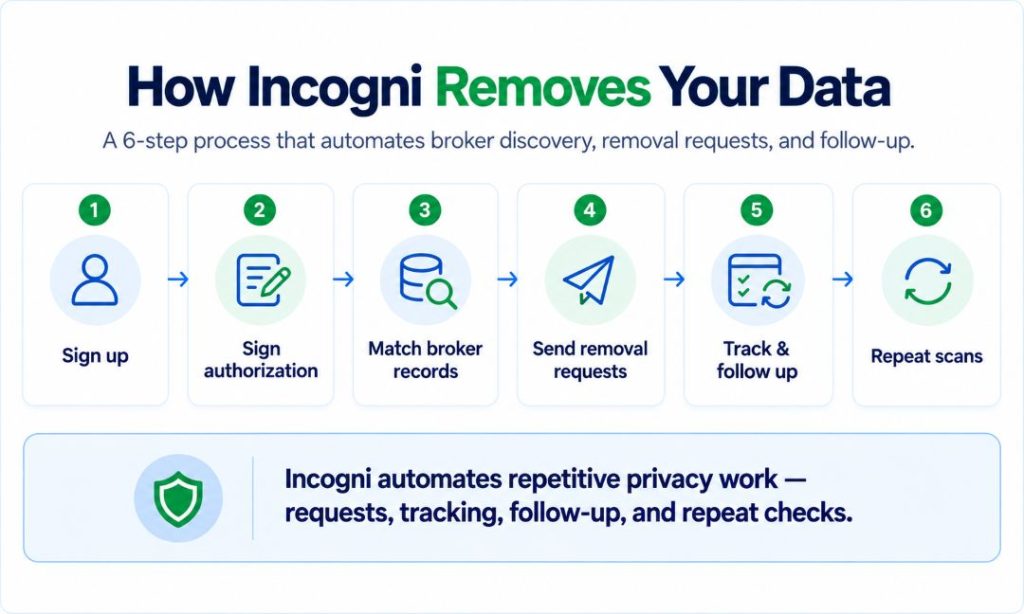
The data removal process generally works like this:
- You provide identity details and sign authorization.
- Incogni selects relevant companies from its coverage list.
- Incogni sends removal requests using broker-specific channels.
- Responses and statuses appear in the Incogni dashboard.
- Non-responsive companies receive follow-ups.
- Repeat requests are scheduled where records may return.
The Incogni tool is mainly valuable because it can automate repetitive work that would otherwise involve many separate forms, emails, and follow-ups. These removal requests are then tracked rather than treated as finished at submission.
Does Incogni Scrape Broker Sites, Use APIs, or Submit Legal Requests?
There is no single universal channel. Public listings may be searchable, while private systems require direct privacy workflows. Incogni’s core service is sending opt-out and deletion requests using applicable rights and the customer’s authorization.
A request may be submitted through a form, email, portal, or another broker-specific channel. Incogni doesn’t claim a universal API into every data broker.
What Happens After a Removal Request Is Sent?
Incogni tracks each case by status. Its guide to data removal statuses in the dashboard explains that “In progress” means a company is processing it; “Scheduled” includes future follow-ups or recurring activity; “Completed” means the company either removed the record or reported that it did not have one.
Common outcomes include:
- The company confirms deletion.
- It reports no matching profile.
- The case remains open while a response window runs.
- Incogni follows up after non-response.
- A future request is scheduled because data may return.
- The broker may place the person on a do-not-republish list.
A completed status is therefore useful, but it does not always prove that a visible listing existed before the request. A completed case could also mean that Incogni received confirmation that no matching record was found.
How Does Incogni Handle Custom Removals?
Custom removals are a premium feature for eligible URLs outside the Standard coverage list. According to Incogni’s documentation on removing information from sites outside regular coverage, customers with an Unlimited or Family Unlimited plan can submit custom removal requests and have a privacy specialist handle them manually. Incogni describes these as unlimited custom removals on qualifying plans.
The URL or website must still qualify for removal. The same custom-removal policy lists court records, government websites, publications about criminal proceedings, social accounts, blogs, and forums among the exclusions.
This custom data removal option is most useful when you find a smaller directory or niche site that standard automation does not cover.
How Many Data Brokers Does Incogni Cover?
Incogni says its core broker coverage reaches 420+ data broker sites.
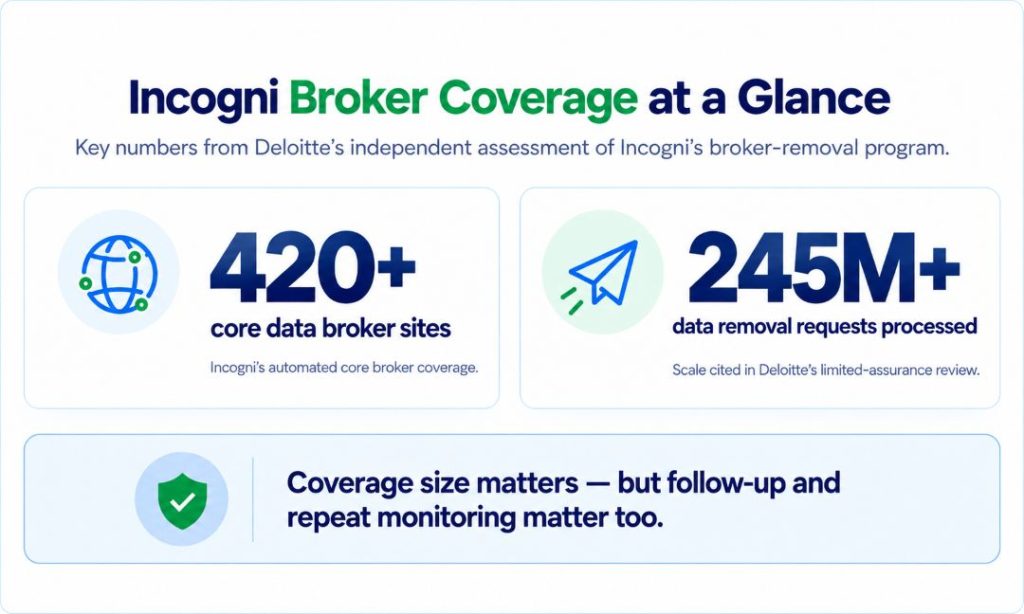
In its independent limited assurance report on Incogni, Deloitte reported that, as of July 18, 2025, nothing came to its attention causing it to believe Incogni covered fewer than 420 brokers or received confirmations from fewer than 420. The report also referenced more than 245 million data removal requests processed.
For anyone researching how to remove your data from data brokers, the headline number is only part of the picture. Incogni targets data held by data brokers and people search sites, including many major data brokers; follow-up and repeat checking matter too.
ClearNym is another option to compare for U.S.-focused removal. The ClearNym Personal plan includes 262+ sites, weekly protection rescans, re-removal when data returns, and a 14-day free trial before the first charge.
Does Incogni Show Real Proof That Your Data Was Removed?
Incogni provides status tracking and request history, but a completed status is not always proof that a visible listing was removed. Its explanation of dashboard removal statuses says “Completed” includes both companies that removed data and companies that confirmed they did not have it.
The dashboard shows how removal requests progress; it does not necessarily provide a before-and-after image for every listing or show every specific data field removed.
What Is a Verified Removal and What Counts as Proof?
The strongest evidence is a broker confirmation or a before-and-after check showing a public listing disappeared. Deloitte’s limited assurance report found no issue with Incogni’s claim that 420+ brokers provided removal confirmations as of its assessment date.
That assurance supports Incogni’s overall process, but it does not verify every individual removal or guarantee how a broker will respond in the future.
Where a broker’s database is private or does not expose a searchable consumer profile, the result should be labeled “confirmed by broker” rather than “independently verified.”
How Long Does Incogni Take to Remove Your Data?
There is no single deletion time. Some brokers respond quickly, while others may take several weeks. Incogni continues tracking cases instead of treating submission as success.
A practical timeline is:
- First days – requests begin after setup.
- Following weeks – companies process, reject, or verify requests.
- Later – Incogni follows up on overdue cases.
- Future cycles – repeat requests address data that may return.
How quickly Incogni clears a particular listing depends on the company, jurisdiction, match quality, and verification requirements.
What Happens When a Data Broker Refuses or Ignores Incogni?
Incogni says in its authorization-form documentation that its authorization can support complaints to relevant privacy authorities after a refusal. Unresolved removal requests may remain open while the service follows up. This does not make every disputed request enforceable.
Why a request may fail or stall: a broker may be unable to verify the person, the request may fall outside the applicable jurisdiction, or the company may rely on a lawful exemption. In other cases, Incogni may be contacting a page it does not control, or the source may fall outside eligible removal categories, such as a government, court, or news page.
What happens next: Incogni may continue following up, request additional verification, or escalate the issue where applicable. If the source is outside its coverage or legally exempt, the case may remain unresolved and require a different removal route.
Do Removed Listings Come Back?
Yes. Brokers can rebuild profiles from public records, commercial feeds, or newly collected information. Removal persistence depends on continued checking, not one successful request.
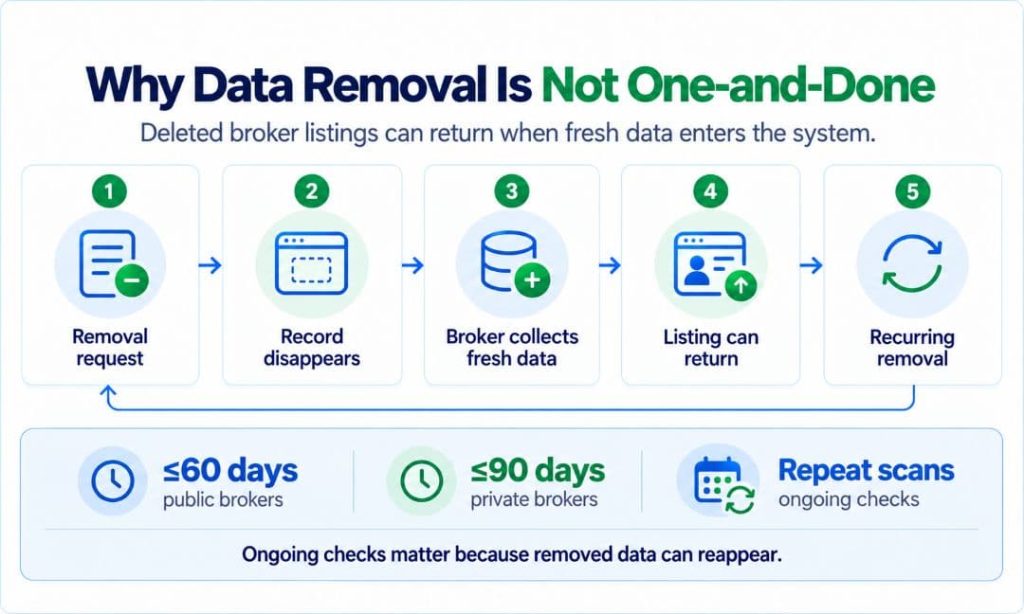
According to Deloitte’s independent assessment of Incogni’s removal practices, recurring requests occurred at intervals no longer than 60 days for public brokers and 90 days for private brokers unless the person had been added to a suppression list. That recurring scan is one reason subscription-based maintenance exists.
For people trying to remove personal information over time, ClearNym offers another approach: its paid Personal plan advertises weekly rescans and re-removal if data returns.
What’s the Difference Between Incogni Standard and Unlimited?
The Incogni Standard vs Unlimited decision mainly concerns custom work. According to Incogni’s current plans, the Standard plan covers 420+ core sites, multiple identifiers, and recurring removals. The Unlimited plan adds specialist-handled custom removals for eligible pages beyond the core network, including custom removal requests you submit.
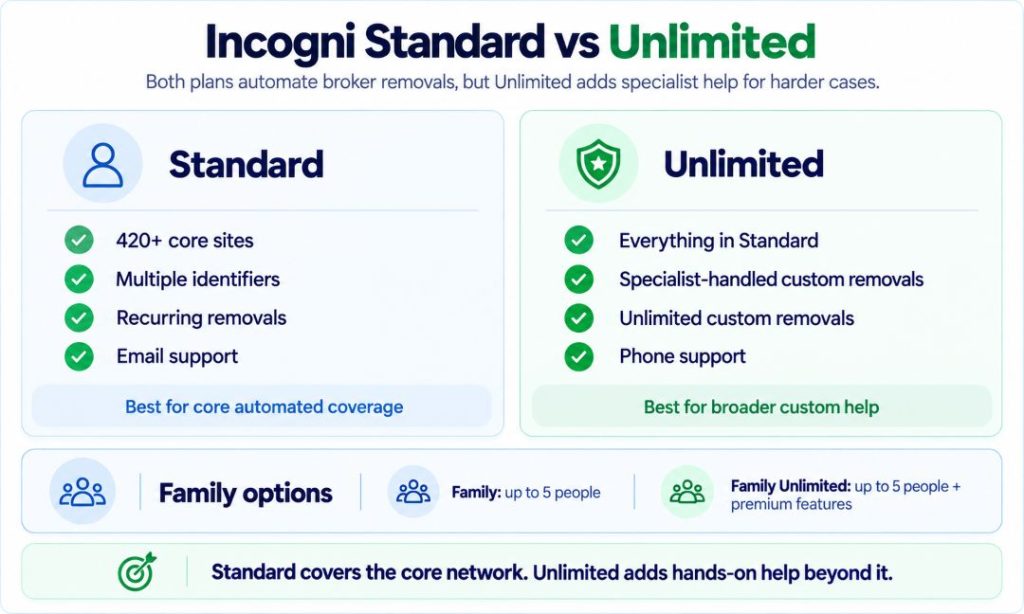
Both plans include automated data removal. The main differences are:
- Standard plan – core network and recurring removal.
- Unlimited plan – Standard features plus unlimited custom removals.
- Family – core protection for up to five members.
- Family Unlimited plan – premium features for up to five members.
- Support – email support is generally available; phone support is available on Unlimited tiers.
Incogni also markets a U.S.-only Protect product with dark web monitoring and up to $1 million in identity theft insurance. Incogni’s plans and pricing documentation explain that this identity theft protection is separate from basic broker-removal coverage.
How Much Does Incogni Really Cost After Renewal?
Incogni pricing uses introductory discounts, so an Incogni subscription may renew at a higher regular rate. The current pricing page showed first-year annual offers renewing at higher regular rates when checked on September 23, 2026.
Incogni does not offer a free trial. Instead, its current subscription terms and offers provide a 30-day money-back guarantee on the initial purchase. It also has a Free Exposure Scanner, which can check potential exposure without a paid account.
First-Year Price vs Renewal Price
Current U.S. annual pricing shows the difference:
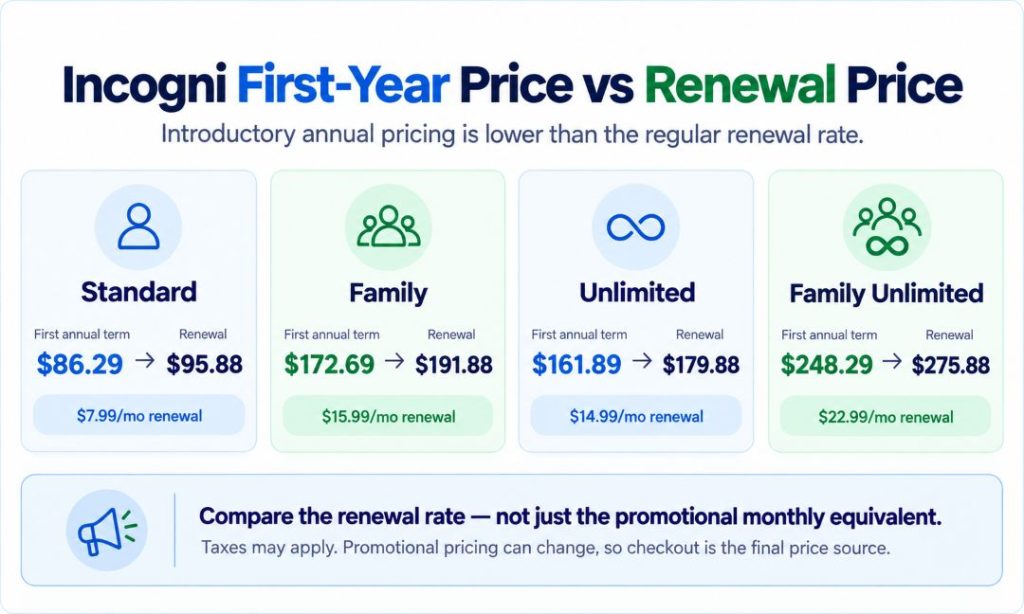
The infographic shows Incogni’s first-year annual prices rising at renewal: Standard from $86.29 to $95.88, Family from $172.69 to $191.88, Unlimited from $161.89 to $179.88, and Family Unlimited from $248.29 to $275.88. At renewal, that equals $7.99, $15.99, $14.99, and $22.99 per month, respectively.
The Incogni cost per month shown during a promotion should therefore be separated from the renewal rate. The Incogni pricing page notes the current plan amounts, while taxes may apply.
Individual vs Family Plans
The Incogni Family plan covers up to five people. Family Unlimited extends premium custom-removal access to those members.
An annual plan can lower the effective monthly price, but it requires upfront payment. Check the renewal amount before purchasing.
The family option is most cost-effective when several people in the same household would otherwise need separate subscriptions. Each member should still be treated as a separate profile for matching and removal purposes, since names, email addresses, phone numbers, and past addresses differ. Before choosing Family Unlimited, check whether multiple members actually need custom removals.
Incogni vs Manual Opt-Out: What Are You Paying to Automate?
DIY removal can be free, but every data broker may have a different removal flow, verification step, confirmation email, and reappearance risk.
| Factor | Doing It Yourself | Using Incogni | Net Trade-Off |
| Time investment | Find and contact sites yourself | Automate routine submissions | Pay to avoid repetitive work |
| Legal complexity | Interpret each workflow | Uses prepared privacy-request flows | Less admin, not legal representation |
| Tracking effort | Maintain dates, URLs, and replies | Central tracking | Easier oversight |
| Recurring maintenance | Recheck and resend opt-out requests | Automate repeat requests | Subscription replaces upkeep |
You are paying for scale and maintenance, not a secret deletion method.
Where Does Incogni Work?
Incogni’s guide to countries where the service is available lists the U.S. and listed territories, Canada, the UK and Isle of Man, Switzerland, Norway, Iceland, Liechtenstein, and EU member states.
Coverage still differs by location because privacy rights and broker activity vary. For buyers, the practical question is not just whether Incogni is available in a country, but whether the brokers most relevant to that market are actually covered. U.S. users are more likely to encounter people-search sites and state-specific privacy rights, while European users may rely more heavily on GDPR-based deletion rights.
Does Incogni Remove Data from Google, Public Records, and Social Media?
Not generally at the source. Incogni’s custom-removal eligibility rules exclude court records, government websites, social media accounts, blogs, forums, and certain criminal-proceeding publications.
Google is a separate layer. Google’s Results about you guidance explains that eligible results containing personal information such as an address, phone number, email, or certain government IDs can be removed from Search, but removing a result does not delete the source page.
This distinction matters when defining removal needs: broker deletion and search-result de-indexing solve different problems.
Does Incogni Reduce Spam Calls and Emails?
Incogni helps reduce one route through which contact details circulate, but it is not a spam blocker. Marketing lists, breaches, phishing, apps, and older datasets can still generate unwanted contact.
The practical limits are straightforward:
- Broker removal may make it harder to sell personal details to marketers.
- It does not block calls or filter email.
- It cannot recover credentials already leaked on the dark web.
- New data collection can create newly exposed data.
- Less public information does not guarantee an immediate drop in spam.
On the Incogni Trustpilot review page, some customers report fewer calls or emails, while others report little improvement. These are individual experiences, not controlled evidence.
Real User Reviews — What People Like and Dislike About Incogni
The Incogni Trustpilot profile showed about 2,979 reviews when checked, a 4.3 TrustScore, 72% five-star reviews, and 9% one-star reviews. Those Incogni ratings lean positive overall.
The statements below are based on this analysis and do not reflect the opinion of our team.
Pros
- Noticeable spam reduction for some users.
- Helpful, responsive customer support.
- Hands-off removal and regular progress updates.
Cons
- Results can vary, especially for phishing.
- Some features and plan limits may not be immediately clear.
- Removal progress can feel difficult to verify independently.
What Are Incogni’s Biggest Limitations?
The main limitations are:
- It cannot erase every source on the internet.
- “Completed” can mean removed or not found.
- Standard lacks the broader premium custom removals workflow.
- Matching requires identifying user data.
- Records can return after deletion.
- There is no traditional free trial; the refund period starts after payment.
Cancellation and refunds are separate. Incogni’s company and account information explains the service structure, while the current Incogni subscription terms provide for cancellation of auto-renewal with paid access continuing to the end of the term and a 30-day money-back guarantee on the initial purchase.
Incogni vs ClearNym and Other Removal Services
A useful removal services comparison should focus on workflow, not just the biggest coverage number.
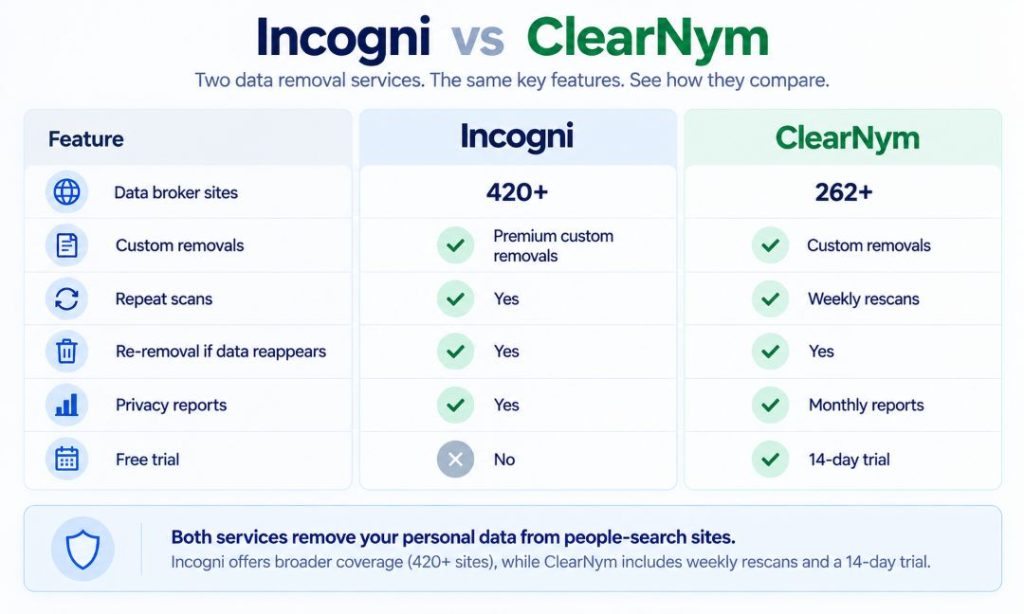
Incogni offers 420+ core sites plus premium custom removals. The ClearNym pricing and coverage page includes 262+ sites, weekly rescans, re-removal, monthly reports, and a 14-day trial.
Incogni competitors such as DeleteMe, Optery, Privacy Bee, and Kanary use different mixes of scanning, privacy-request handling, manual work, and reporting. Personal data removal services can therefore look similar while producing different levels of maintenance and evidence.
For U.S. users focused on online privacy by removing broker listings and checking repeatedly for returns, ClearNym is a credible alternative. Incogni offers broader international availability; ClearNym may fit better when U.S.-focused coverage and weekly monitoring are the priority.
Final Verdict: Who Is Incogni Best for, and Who Should Skip It?
Incogni is suited to people who want a data removal service to automate recurring broker work, live in a supported region, and would rather not manage hundreds of data sources themselves. The Unlimited plan becomes more useful when you often find eligible pages outside the core network and want specialists to handle additional eligible URLs.
It is less compelling if you have only a few listings, expect deletion from government databases or social platforms, or mainly need breach recovery and credit monitoring.
To say that Incogni is one of the best data removal services for your needs, its broad automation and premium custom handling should match the sites you actually need covered. ClearNym can be more suitable for U.S.-focused users who value weekly rescans and a true 14-day trial. Neither service is the right choice in every case.
Before paying, run a free scan and compare your likely coverage, renewal pricing, and maintenance needs. Incogni offers an efficient way to automate recurring cleanup; ClearNym gives U.S. users another option with a different monitoring schedule.
Key Takeaways
- Incogni is owned by Surfshark and uses signed authorization for broker-removal work.
- Automatic coverage reaches 420+ sites; premium custom removals extend beyond that network.
- Customers provide identifying details so requests can match the correct records.
- Standard covers core automation; Unlimited adds specialist-handled custom work.
- Promotional annual pricing renews at higher regular rates.
- ClearNym offers a U.S.-focused alternative with 262+ sites, weekly rescans, and a 14-day trial.
In short, Incogni delivers useful recurring broker cleanup, but its removal capabilities do not extend to every public record, social profile, search result, or leaked credential.
FAQ
Canceling auto-renewal leaves paid access active until the term ends. Recurring work then stops; deleting the account is separate, so cancellation does not immediately erase the account or its history.
Only when that material appears on an eligible removable page. Incogni generally cannot remove social posts, forum content, or leaked passwords from criminal breach databases and other dark-web sources.
Not always. Incogni can track requests and responses, but private brokers do not necessarily disclose every field they hold, so the service cannot promise a complete inventory of each broker profile.
No. Source-page deletion may later change search results, but Incogni is not Google’s removal system. Google handles eligible search-result requests separately through tools such as “Results about you.”
Yes, but matching depends on extra identifiers. Address, date of birth, email, and, for U.S. users, phone number help distinguish your profile from records belonging to people with similar names.
References
- Incogni, “About Us.” https://incogni.com/about-us
- California Attorney General, “California Consumer Privacy Act (CCPA).” https://www.oag.ca.gov/privacy/ccpa
- Incogni Help Center, “Why do I have to sign the Authorization form?” https://support.incogni.com/hc/en-us/articles/4906020548754-Why-do-I-have-to-sign-the-Authorization-form
- Incogni Help Center, “Why do you need my phone and date of birth?” https://support.incogni.com/hc/en-us/articles/9061817090322-Why-do-you-need-my-phone-and-date-of-birth
- Incogni Help Center, “Is Incogni safe and can you trust it?” https://support.incogni.com/hc/en-us/articles/33763548498322-Is-Incogni-safe-and-can-you-trust-it
- Incogni Help Center, “What do the data removal statuses on my dashboard mean?” https://support.incogni.com/hc/en-us/articles/4904721869458-What-do-the-data-removal-statuses-on-my-dashboard-mean
- Incogni Help Center, “Can you remove me from sites not covered by regular services?” https://support.incogni.com/hc/en-us/articles/25640663945106-Can-you-remove-me-from-sites-not-covered-by-regular-services
- Incogni, “Deloitte Independent Limited Assurance Report.” https://blog.incogni.com/deloitte-independent-limited-assurance-report/
- ClearNym, “Plans & Pricing.” https://clearnym.com/pricing
- Incogni, “Data Broker Removal Service.” https://incogni.com/
- Incogni, “Free Exposure Scanner.” https://incogni.com/am-i-exposed
- Incogni Help Center, “In which countries is Incogni available?” https://support.incogni.com/hc/en-us/articles/5285682832402-In-which-countries-is-Incogni-available
- Google Search Help, “Find and remove personal info in Google Search results.” https://support.google.com/websearch/answer/12719076?hl=en
- Trustpilot, “Incogni Reviews.” https://www.trustpilot.com/review/incogni.com
- Incogni Help Center, “Plans and prices of Incogni service.” https://support.incogni.com/hc/en-us/articles/26753632381970-Plans-and-prices-of-Incogni-service

Posted by Ava J. Mercer