Privacy Tools
Clearnym vs Incogni vs Optery: Which Service Is Worth It?
See where your personal data appears online
Privacy Writer
A. J. MercerAva J. Mercer
Updated
Read
5 min
See where your personal data appears online
Clearnym, Incogni, and Optery are all effective data broker removal services, but they serve different priorities. Clearnym is best for all-in-one simplicity and visible cleanup, Incogni is strongest for hands-off automation at a lower cost, and Optery stands out for detailed reports and tiered coverage. There aren’t any tools to remove 100% of your data, so the best choice depends on whether you value speed, depth, or ongoing monitoring.
Key Takeaways
- Clearnym is often considered the best data removal service.
- Incogni is strong on automation; Optery is strong on plan depth and proof.
- Optery cost is lowest at the entry level, but deeper coverage costs more.
- All three are legit, yet Clearnym appears to be the most reliable..
- Manual opt-outs work, but paid help is better for repeat checks.
How to Measure Your Data Exposure
Search your full name, phone number, city, current email, and one old address in separate queries. Check the first two pages of results. Check your broker count by noting pages that expose enough detail to identify you. Look for people search sites, copied directory pages, cached results, and old profile pages. An initial scan should include:
- Your name with city and state.
- Your phone number in quotes.
- One current email and one older email.
- One old address and your ZIP code.
What Data Broker Removal Services Do and Why It Matters?

Good data removal services find exposed listings, match them to you, send requests, and recheck later because many listings return. A data removal service may also act as your agent when a data broker requires a formal path. The value is a repeatable system that helps remove your data from many visible listings. A personal data removal service usually handles five core jobs.
| Job | What Happens | Why It Matters |
| Discovery | The service scans search results and broker pages | You see where exposure starts |
| Removal | The service sends opt-outs or deletion notices | You avoid form-by-form work |
| Verification | The service checks whether the page is gone | You get proof, not guesses |
| Re-monitoring | The service watches for reappearance | Old listings often come back |
| Reporting | The service shows status and blockers | You can track removal progress |
The FBI reported that the Internet Crime Complaint Center (IC3) received 859,532 complaints in 2024, with reported losses above $16 billion. Personal data breaches were among the top complaint categories.
How to Compare Clearnym vs Incogni vs Optery
When choosing a data removal service, compare coverage, proof, follow-up, and how much work still lands on you. Incogni and Optery operate on a similar model, but Clearnym feels more complete because search cleanup and broker removals sit in one simpler flow.
Cost and Pricing Options
Price matters, but entry price and real protection are different things. Clearnym is priced like a fuller privacy tool. Incogni offers a cheaper starting point, and Optery offers the widest ladder. Look at what is included, not only the first number. The number of data brokers matters, but the best value comes from visible data broker pages. Here is the pricing snapshot:
| Service | Monthly or Annual Cost | Features Included |
| Clearnym | See current plans on our pricing page | 493+ broker removals, Google cleanup, monitoring, automatic re-removal, unlimited phones, addresses, aliases, monthly report, 24/7 email support |
| Incogni | Standard: $15.98 monthly or $7.99/month billed annually; Unlimited: $14.99/month billed annually | Standard includes automated removals from 420+ sites, multiple emails, addresses, phone numbers, and 24/7 support; Unlimited adds 2,000+ additional sites and unlimited custom removals |
| Optery | Optery Core: $3.99 monthly or $39 yearly; Extended: $14.99 monthly or $149 yearly; Optery Ultimate: $24.99 monthly or $249 yearly | Core covers 365+ sites; Extended covers 540+ with a human agent and screenshots; Ultimate covers 640+ sites, outdated-content help, and unlimited custom removals |
Coverage and Effectiveness of Each Service
Raw site totals help, but they do not tell the whole story. A visible data broker page matters more than a buried listing, and a good data removal service should hit the visible pages first. The better test is whether a service hits the listings most likely to rank in search results or rebuild your profile later. That is why effective coverage and extensive data broker coverage are not always the same thing. For many people, comprehensive data removal means clearing personal information from data broker pages, not chasing hundreds of data broker records nobody sees.
Clearnym blends search cleanup, broker removals, and rechecks. It offers screenshots with opt-out guides and covers many key areas:
- Clearnym targets 493+ data broker sites and pairs that with Google-focused cleanup.
- Includes ongoing monitoring and automatic re-removal, so the approach to data removal stays active.
- Clearnym’s Extended tier adds custom removal requests and white-glove help.
Incogni is built for people who prefer a fully automated, hands-off approach. Additionally, Incogni offers a straightforward signup path and keeps things simple:
- The service covers public and private brokers, not only people search sites.
- Provides automated removals from 420+ sites, access to 2,000+ additional sites, plus unlimited custom removals on Unlimited.
- Incogni automates recurring removal requests, and Incogni demonstrates strong scalability.
Optery focuses on plan depth and visible proof. It offers detailed screenshots, broader tiering, and many ways to scale upward. Whereas Optery may feel more complex, it gives buyers more control:
- Optery covers 365+ sites on Core, 540+ on Extended, and 640+ on Ultimate.
- Provides a humans-plus-machines model on higher tiers, and Optery also includes map-blur help on Extended.
- Ultimate adds unlimited custom removals and outdated-content submissions for search engines.
Incogni and Optery offer broad reach, but both are less tidy than Clearnym. If you compare tools like Incogni or Optery, Incogni excels in ease of use, while Optery isn’t as easy to try. An Incogni subscription fits buyers who want fewer plan options and simpler decisions.
Since 2005, the Identity Theft Resource Center has tracked more than 21.9K data compromises, nearly 12B victim notices, and about 60B exposed records.
Does Your Country or State Change Results?
Yes. Personal information removal services usually work faster where privacy law clearly supports access, deletion, or opt-out rights. California residents have stronger broker-specific tools. People protected by the General Data Protection Regulation may have broader leverage with some companies.
Service footprint matters too. Optery and Incogni provide broad multi-country coverage, but local law still shapes what a broker must remove and what stays public.
User Reviews of Data Removal Services
Reviews matter because results can feel invisible until a dashboard starts showing change. Each service offers a different balance of data privacy, privacy protection, and proof. We analyzed many reviews from real users in open sources. The statements below are based on this analysis and do not reflect the opinion of our team.
ClearNym’s review base is growing, but the feedback is specific and practical. Users often mention real removals, monitoring, and easy tracking.
Pros
- Fast visible results.
- Clear monitoring tools.
- Helpful free scan.
- Simple user experience.
Cons
- Public review volume is still growing.
- Some removals take longer.
- Full value builds over time.
Incogni’s reviews are broad and consistent. Users often describe it as simple, useful, and easy to keep running in the background.
Pros
- Easy to set up.
- Lower spam over time.
- Clear progress updates.
- Saves manual effort.
Cons
- Family coverage can feel unclear.
- Expectations may need framing.
- Results can take time.
Optery reviews often focus on usability, reporting, and steady progress. Users tend to value the visibility it gives them.
Pros
- Clean interface.
- Easy-to-read reports.
- Strong privacy value.
- Helpful support.
Cons
- Family setup could be smoother.
- Search results may lag.
- Some progress feels gradual.
Which Service Is Best for Your Situation?
If you want one service that feels ready and helps remove personal information with no trouble, Clearnym is the safest choice.
Between the other two, Incogni is better for simple automation, while Optery gives buyers proof. For buyers who hate plan math, Incogni is the better choice. Incogni and Optery both offer automation and value for buyers. In that narrow matchup, Incogni wins. Clearnym remains the strongest overall option for most users.
DIY vs Paid Services: Is Manual Opt-Out Worth Your Time?
Manual opt-outs can work if you only have a few exposed profiles and enough patience. The problem is that every data broker uses different forms, identity checks, and wait times, and every data broker responds at its own pace. Paid help centralizes discovery, sending removal requests, automated data removal, follow-ups, and rechecks, including repeat data removal requests. The trade-off looks like this:
| Factor | DIY opt-out | Paid service |
| Time | High | Low to medium |
| Coverage | Usually limited to a few broker pages | Better across many broker pages |
| Follow-up | Manual | Often automated removal or assisted follow-up |
| Proof | You track screenshots yourself | Dashboard, logs, or screenshots |
| Reappearance | Easy to miss | Better if the service keeps monitoring |
Types of Information That Can Be Removed
Most tools target the details that make you easy to identify and contact. That includes contact data, identity markers, background clues, and public-facing profiles copied by data brokers and people search sites. The goal is personal data removal that breaks the chain.
Contact Details That Are Most Commonly Removed

Contact data is usually the first problem people notice. If you want to remove your address from search results, start with the biggest people search sites and copy search listings. Phone numbers and emails matter just as much because they feed spam, phishing, and account-matching. These details are usually targeted first:
- Home address and past addresses.
- Mobile and landline numbers.
Identity Data That Exposes Your Profile
Identity signals make a page feel confirmed even when some details are wrong. A listing becomes riskier when it combines age, relatives, and location hints into one record. That is how shadow profiles keep circulating. The most common identity elements are:
- Full name and name variations.
- Age or year of birth.
- Names of close relatives.
Background Information Linked to Your Identity
Background details can make a profile look deeper than it really is. Some services can scrub identity details from data broker pages even when a listing mixes in employer history, education clues, or property ties. Common examples include:
- Employer or past workplace.
- Property ownership clues.
Online Profiles and Public Listings
A lot of risk comes from pages that are easy to index and copy. That includes people-search profiles, directory pages, cached snippets, and search results that surface old pages. Good services try to delete your data trail from these visible layers first.
The Real Limits of Data Removal Services
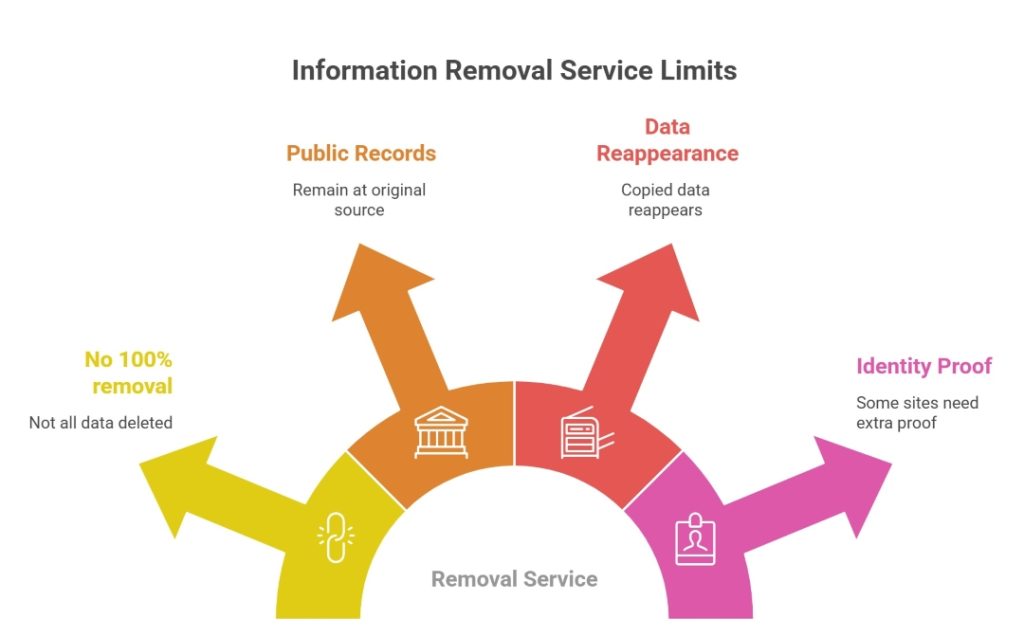
Even the best information removal service has limits. No provider can promise 100% deletion because the web keeps copying itself, and some records are legally public. Incogni doesn’t erase original court files, and Optery doesn’t either. A service can often suppress or remove copies, but public records remain at the source. Results also depend on identity matching and response time. Keep these limits in mind:
- No 100% removal across the whole Internet.
- Public records remain in the original government sources.
- Copied data can reappear on new sites.
- Some sites need extra identity proof before action.
How Do Privacy Laws Help with Online Data Removal?
Privacy law does not remove listings by itself, but it gives you leverage. A service that knows how to use deletion, access, and opt-out rights can work faster than a user reading privacy policies one by one. Stricter rules also push brokers to publish contact paths and response metrics. The main frameworks are below:
| Law | Region | User Rights | Effectiveness |
| GDPR | European Union | Access, erasure, objection, portability, restriction | Strong when the company falls under EU rules |
| CCPA/CPRA | California | Know, delete, correct, opt out of sale or sharing, limit sensitive data use | Strong for California residents dealing with covered businesses and brokers |
| Colorado Privacy Act | Colorado | Access, delete, correct, portability, opt out of sale, targeted ads, profiling | Useful, but response quality still varies |
| Virginia Consumer Data Protection Act | Virginia | Access, delete, correct, portability, opt out of sale, targeted ads, profiling | Helpful, though narrower in practice than California |
How to Check If Your Data Comes Back Even After Removal
Removal is not a one-time task. Brokers buy fresh feeds and repost older details, which is why continuous monitoring matters. A good service should help you spot return listings and timing. For long-term control of your online privacy, use this routine:
- Re-run name, phone, and address searches every few weeks.
- Check Google for old profile URLs and cached snippets.
- Review the dashboard for reappearance alerts and status changes.
- Contact customer support if a high-risk listing returns after completion.
FAQ
Some brokers ignore requests because identity matching is weak, forms move slowly, or the broker buys the same record again before the deletion cycle finishes.
No. Optery can help remove broker pages or search listings that copy public filings, but it does not remove the original court record or source document.
Incogni plans are mainly automated. On higher tiers, Incogni offers unlimited custom removals and live support for cases that need extra handling.
Yes. Incogni covers details to match and remove listings, not to resell them, and Deloitte provided assurance that Incogni did not sell customer data.
Usually not. One email can be a strong link, but most profiles connect names, phones, addresses, relatives, and old usernames, so broader cleanup is still needed.

Posted by Ava J. Mercer