Privacy Tools
Is DeleteMe Worth It? Decide If Removal Proof Justifies the Price
DeleteMe is worth it for people who want a hands-off data removal service with human review, custom removal requests, and recurring follow-up. It is less compelling if you mainly want the lowest-cost automated opt-outs or expect permanent removal from public records, news sites, or every Google result. Its value depends on whether verified removals and manual exception handling justify the higher price.
See where your personal data appears online
Privacy Writer
A. J. MercerAva J. Mercer
Updated
Read
5 min
See where your personal data appears online
Is DeleteMe Legit?
DeleteMe is a legitimate consumer privacy business operated by Abine, Inc. DeleteMe is a data removal service, specifically a personal data removal service, rather than an identity theft protection service. It focuses on exposed records, not credit monitoring, fraud insurance, or account recovery.
To ask “Does DeleteMe actually work?”, separate request submission from completed removal and consider whether the record stays gone. Its documentation lets users evaluate each stage instead of relying on a vague promise to erase them online.
Is It Safe to Give DeleteMe Your Personal Information?
DeleteMe privacy matters because accurate searches require identifying details. Its security guidance says the company maintains SOC 2 Type 2 compliance, uses AES-256 encryption at rest and TLS 1.2 in transit, and applies access controls and multi-factor authentication.
Those controls reduce risk, but no security system eliminates risk. Read current privacy policies, enable two-factor authentication, and submit only fields needed for matching. A privacy service should reduce exposure, not collect data merely because a form allows it.
Overall, DeleteMe appears reasonably safe to use based on the security measures it publicly documents, but sharing personal information with any third-party service still carries residual risk.
What Personal Information Does DeleteMe Require?
If you are asking “what data does DeleteMe collect?”, the member registration guide is unusually specific. The Data Sheet may ask for names, date of birth, email addresses, phone numbers, addresses, employer details, relatives, and authorization. DeleteMe does not require a Social Security number or bank information in that sheet, although it still needs payment details for billing.
The purpose is identity matching: an old address or phone number can separate the correct profile from others with the same name. The public guide lists prompted fields but does not mark each as required or optional; authorization is explicitly optional.
| Data Type | Why DeleteMe Needs It | Required or Optional | Privacy Risk | User Action |
| Name / aliases | Match current and former profiles | Prompted; requirement not stated | Links identities | Add only names tied to you |
| Address history | Separate similar names | Prompted; requirement not stated | Reveals location history | Include relevant addresses |
| Phone | Find phone-based listings | Prompted; requirement not stated | Links contact data | Verify current/old numbers |
| Match exposed accounts | Prompted; requirement not stated | Connects accounts to identity | Submit relevant addresses | |
| Date of birth | Distinguish similar profiles | Prompted; requirement not stated | Sensitive identifier | Check accuracy |
| Relatives | Confirm household links | Prompted; requirement not stated | Exposes family ties | Add only when useful |
| Employer | Match professional listings | Prompted; requirement not stated | Reveals work history | Include when relevant |
| Authorization | Permit third-party action | Optional | Grants limited authority | Read scope before signing |
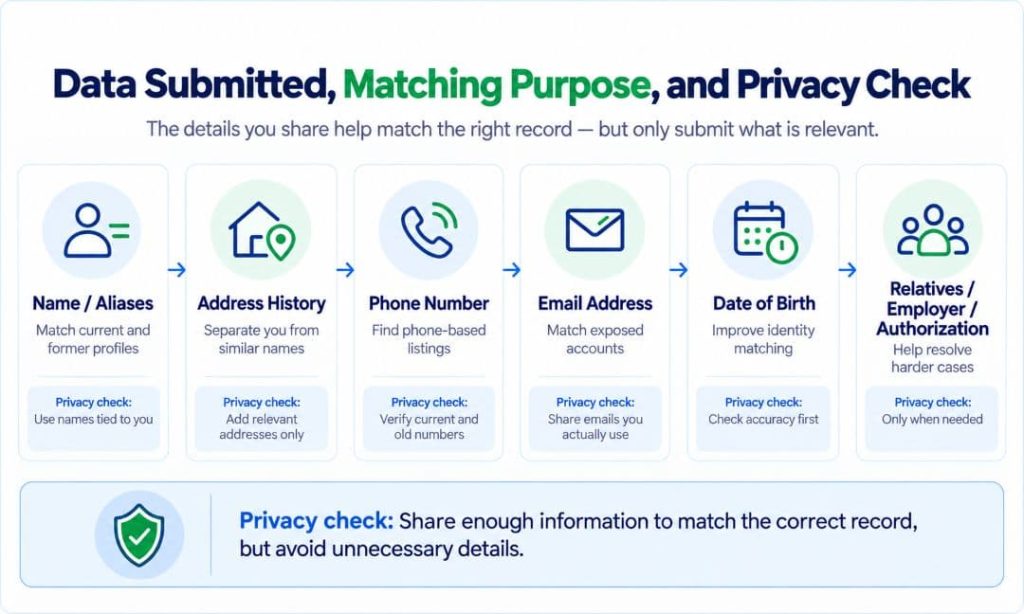
The infographic covers eight categories: names, addresses, phones, emails, date of birth, relatives, employers, and authorization. Give enough information for a reliable match, but avoid fields that do not help the search.
Why Does DeleteMe Need an Authorization Form?
Some data brokers refuse third-party requests unless the provider can show that it is authorized to act for the person named in the record. The company describes its authorization form as an optional, limited power of attorney for harder cases.
Declining it does not make the account unusable, but some removals may require direct action. Read the scope first; authorization should serve a specific purpose, not become something you agree to without reviewing.
How Does DeleteMe Actually Remove Your Data Step-by-Step?
The data removal process combines discovery, review, and follow-up. When you use DeleteMe, specialists search for matches and submit removal requests on your behalf. The reporting guide says the first Privacy Report arrives in about seven days; the consumer pricing page lists quarterly reports.
The workflow is easier to understand as a sequence:
- Complete your account and Data Sheet.
- Scan supported data broker sites for likely matches.
- Review the listing before acting on it.
- Send the removal request through data brokers’ processes.
- Complete any verification data brokers require.
- Track the case until removal or a documented limitation.
- Recheck later for republished records.
If you submit a URL outside normal coverage to the DeleteMe service, the custom team can investigate it through the DeleteMe dashboard.
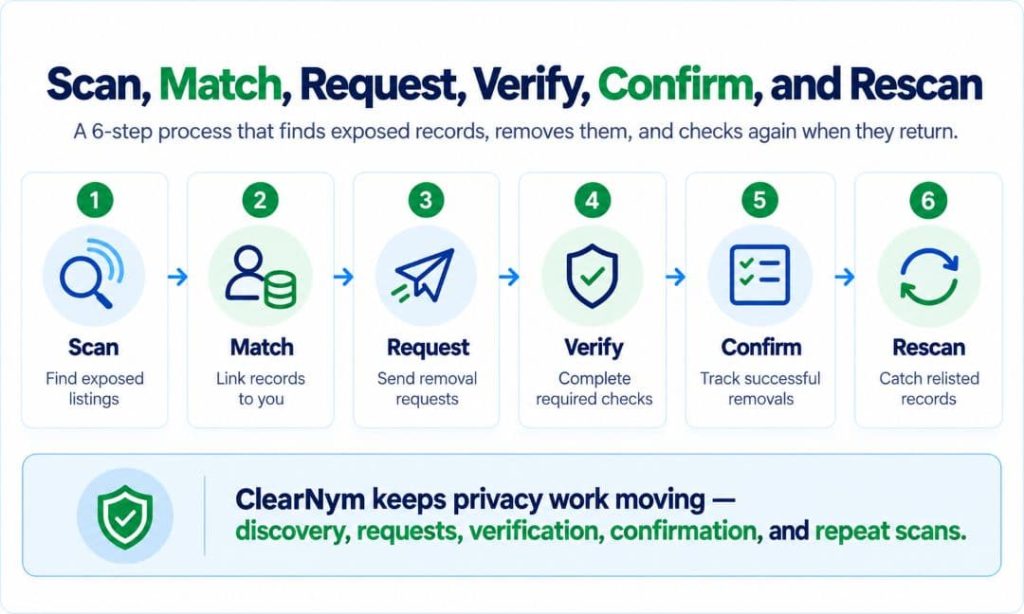
The infographic shows six stages from discovery through rescanning. A request is only the midpoint; verification, removal confirmation, and later checks determine whether the exposure stays down.
How Many Data Brokers Does DeleteMe Really Cover?
Coverage figures are easy to misread. The official list of data brokers, updated September 17, 2026, includes 969 sources where records have been found and removed. It is a historical list of sources, not proof that all 969 sources are checked for every customer on every cycle.
The current plan guide puts the number of data broker sites in Standard at over 30 top sources. This is why data removal services like DeleteMe should be compared using scheduled scans, custom reach, and proof. Data brokers change their opt-out systems, so static coverage totals can become outdated quickly.
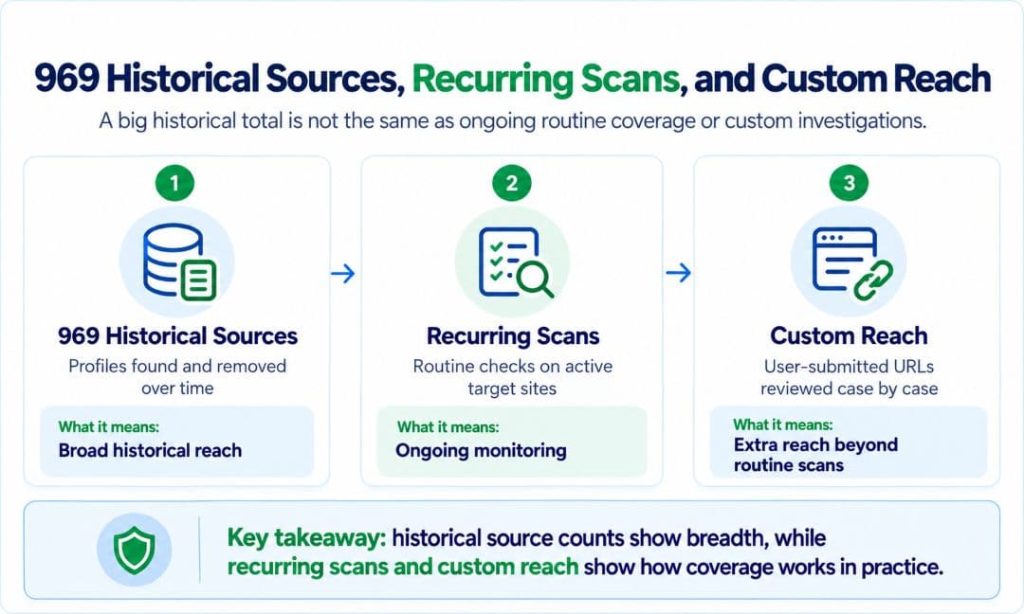
The infographic separates the 969-source history from scheduled checks and custom cases. The larger number shows reach over time; recurring coverage shows what is checked routinely.
Standard Coverage vs Custom Coverage
Standard coverage starts with proactive scans, while custom coverage starts with a specific URL or exposure. According to the custom request instructions, a custom removal request is reviewed, the listing is verified, an opt-out is sent when possible, and the case is tracked through completion.
| Coverage Type | Discovery Method | Human Involvement | User Action Required | Monitoring After Removal | Plan Limits |
| Standard | Proactive scan | Review plus exceptions | Usually no; some data brokers require verification | Recurring checks | Plan-specific |
| Custom | User-submitted URL | Higher manual review | Yes: URL/details; sometimes direct verification | Case tracking and repeat action where supported | Standard 40; Premium 60 |
A custom removal request helps when information from data broker websites falls outside the normal scan. Success still depends on data brokers or publishers offering a workable removal path.
Does DeleteMe Actually Confirm Removals or Just List Requests?
A first report is not a completed removal. The official report documentation says it shows where data was found and what is being done, not that every listing has disappeared.
Later reports distinguish between exposures reviewed, sites with your information, and exposures removed. That is useful process evidence, but before-and-after screenshots are not promised for every site. Users who want visual proof should account for that difference.
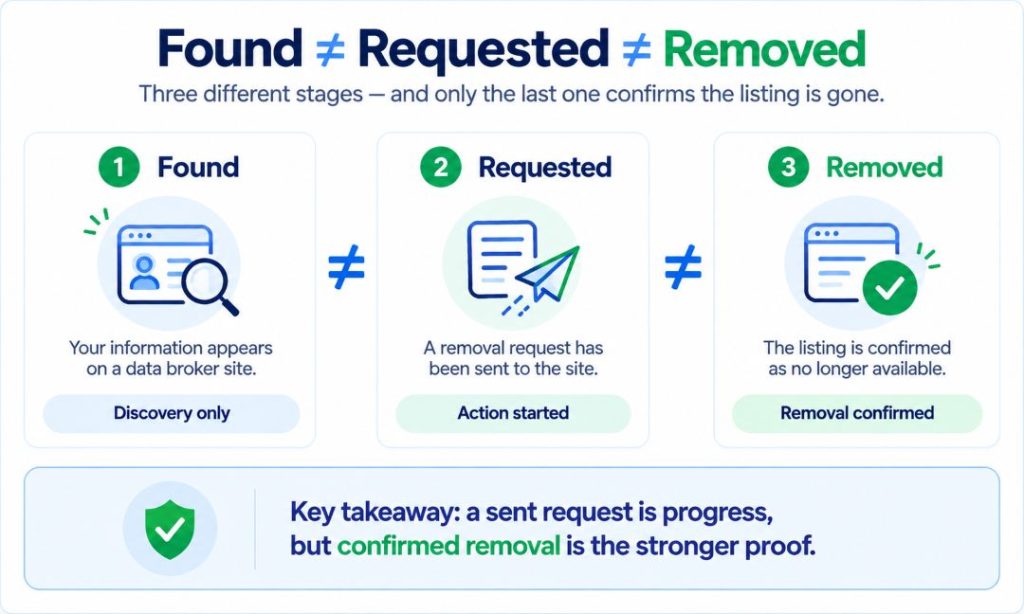
The infographic distinguishes discovery, an outgoing removal request, and completed removal. The first update shows progress; completed status is stronger evidence, while screenshot proof is not guaranteed for every listing.
Does DeleteMe’s Human Review Actually Add Value?
Manual review matters when old addresses, aliases, relatives, duplicates, or common names confuse automation. DeleteMe provides human handling for these edge cases, one of the more meaningful DeleteMe features.
A service like DeleteMe makes the most sense when you want exception handling, not just form submission. Automation is efficient on standard data broker sites; a person can investigate changed workflows and ambiguous profiles. That reduces troubleshooting without guaranteeing success.
Why Does Your Personal Information Come Back After Removal?
Data brokers rebuild profiles from public records, commercial files, sign-ups, and other data brokers. A successful deletion can therefore be followed by a new record weeks or months later.
DeleteMe offers to monitor supported sources, so recurring monitoring is part of the subscription rather than a bonus feature. Standard includes quarterly reporting and four scans per year, while Premium increases the scan frequency to six times per year.
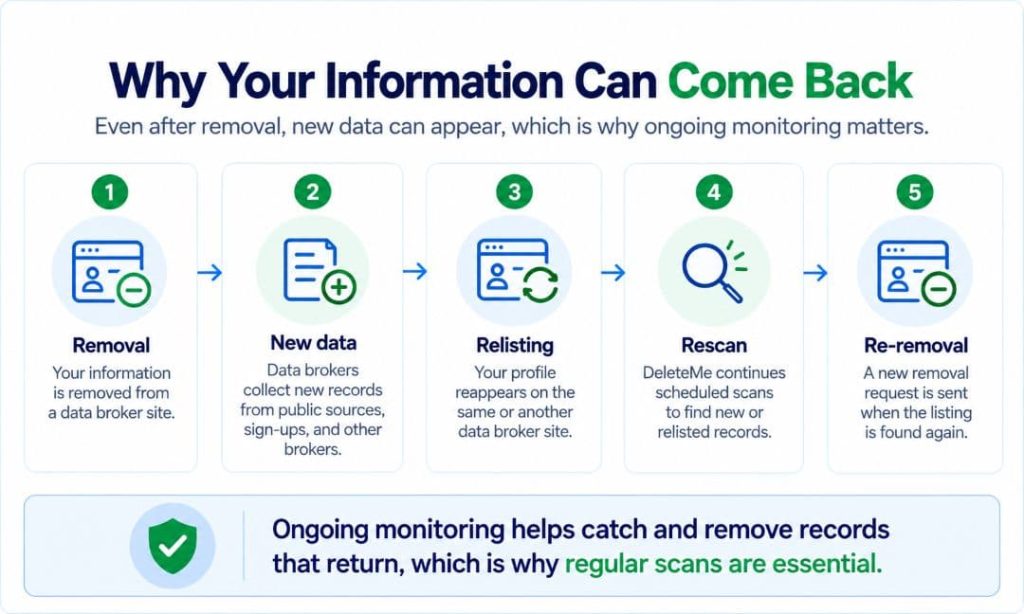
The infographic shows why a one-time sweep is not enough. Standard lists four scans yearly and Premium six, a difference of two scans per year.
What Is Data Relisting and Why Does It Happen?
Relisting means a removed profile appears again. The trigger can be a fresh source file, a new address, a duplicate identity, or newly collected personal data from broker sources.
That does not mean the original request failed. For ongoing online privacy, focus on scan frequency, re-removal, and whether repeat exposures are clearly reported.
Relisting is also useful to track by source, not just by total profile count. If the same broker republishes the same record after a confirmed removal, that suggests the opt-out did not create permanent suppression; if a new broker appears instead, the exposure came from a different part of the data ecosystem.
DeleteMe Pricing — Individual, Family, Premium, and Renewal
Public pricing plans for DeleteMe include individual, couple, family, and Premium options, with one- and two-year billing terms available for Standard plans. An official consumer-plan comparison lists $129 for one person, $229 for two, and $329 for four for one year; two-year totals are $209, $349, and $499. The Premium pricing page lists $180 yearly and says subscriptions auto-renew unless canceled.
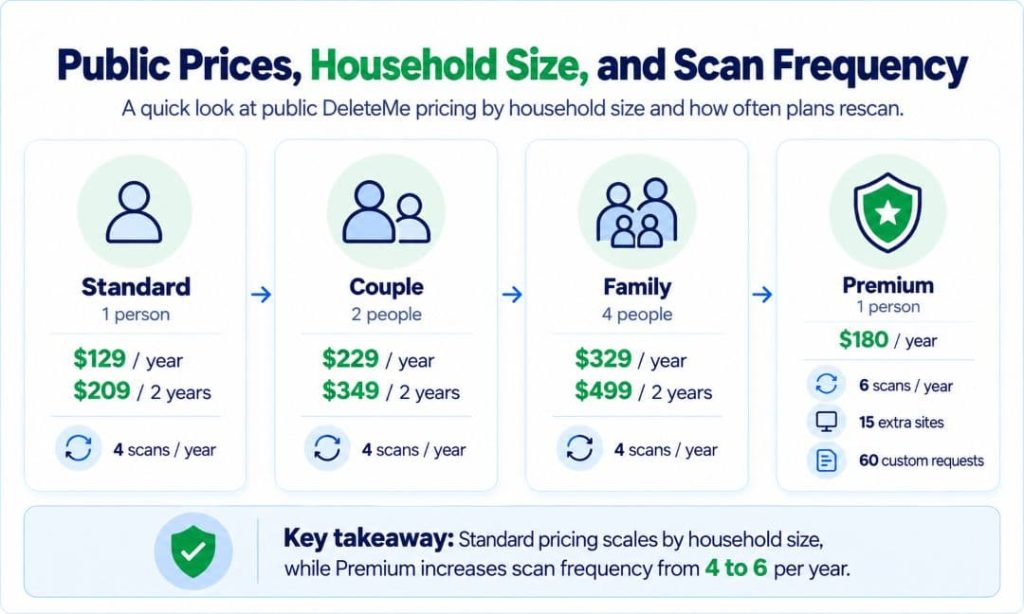
The infographic compares 129/229/$329 annual pricing with 209/349/$499 two-year pricing for one, two, and four people. Premium is $180 annually and raises scans from four to six, custom requests from 40 to 60, and adds 15 sites.
DeleteMe plans and pricing clearly show the initial subscription cost, but they do not promise a permanently fixed renewal price. DeleteMe subscriptions renew automatically unless you turn off auto-renewal. It’s also worth checking the next charge. DeleteMe also lets customers turn off renewal.
What Can DeleteMe Remove, and What Can’t It Remove?
DeleteMe can remove many people-search profiles held by data brokers when a valid opt-out exists, but no commercial provider can erase every lawful page. DeleteMe removes your personal information at supported sources; it cannot rewrite government databases, force every publisher to cooperate, or prevent future collection everywhere.
For readers trying to remove personal information, ClearNym is worth comparing. Its Personal plan lists 262+ data broker sites, weekly protection rescans, re-removal when records return, and monthly reports. It also starts with a 14-day free trial before the first subscription payment.
The boundary is clear in three cases:
- Supported people-search or broker profile: normal data broker removal target.
- Difficult page with a workable contact path: possible custom case.
- Official public record or lawful page with no removal route: usually remains available.
Does DeleteMe Remove Google Search Results?
Not directly. The company’s Google search guidance explains that search engines usually index a source page rather than own the underlying record. The source generally has to be removed or changed first.
DeleteMe will send removal requests to the source website where supported. Once a page changes, Google can refresh its index; outdated-result tools may also help when an old cached version remains.
Can DeleteMe Remove Public Records?
Usually not from the government source. Property, licensing, voter, and court records may be public by law. A provider may still remove a republished copy or personal information from data broker pages while the official record remains.
Fewer copies held by data brokers can reduce how easily someone can find the information without changing the original record’s public status.
The practical distinction is between removing access points and removing the underlying record. DeleteMe may reduce how often a public record is copied, indexed, or surfaced through people-search sites, but the authoritative government record can remain available through the agency that maintains it.
What If a Site Has No Opt-Out Process?
A manual team can investigate another contact route, but success is not guaranteed. When a normal opt-out process is missing, the options are:
- Use the publisher’s privacy or contact channel.
- Invoke an applicable privacy right.
- Ask for a custom investigation.
- Act directly if the publisher rejects third-party requests.
- Accept that lawful content may remain when no removal basis exists.
The custom-removal documentation also notes that the team verifies a submitted listing, attempts the available opt-out path, and keeps the customer updated.
How Fast Does DeleteMe Work?
The first account report is expected in about seven business days, according to official reporting documentation, but it is a progress update, not a completion deadline. Data brokers move at different speeds, and verification can add days or weeks.
Speed depends on the list of data brokers, match complexity, and your response to verification messages. Completed removals matter more than a fast first scan.
How Do Refunds, Cancellation, and Account Deletion Work?
The official refund policy allows a full refund before the first report; afterward, unused subscription time is refunded pro rata. Cancellation and account deletion remain separate actions.
Use the following sequence to avoid mixing them up:
- Turn off renewal if you only want to stop the next charge.
- Request a refund while you are eligible.
- Delete the account if you also want stored account data removed.
- Contact the DeleteMe customer support team if billing, refund, or deletion needs manual help.
Stopping billing does not automatically erase stored personal data in the account.
Does Canceling Delete Your Personal Data?
No. Canceling renewal stops future subscription charges; it is not account deletion. The account deletion guide says deletion terminates subscriptions, deletes associated subscription data, removes dashboard access, and is irreversible.
If you’re learning how to remove your data from data brokers, ClearNym is useful to compare because weekly rescans and re-removal address records that return. With any provider, account deletion should be checked separately from broker removal.
Where Is DeleteMe Available?
The international plan page lists Australia, Belgium, Brazil, Canada, France, Germany, Ireland, Italy, the Netherlands, Singapore, and the United Kingdom in addition to the United States.
Coverage is country-specific because data brokers, legal rights, and common sources vary by market. Check the local plan rather than assuming U.S. coverage carries over. If you have lived in more than one country, check whether the plan can address exposures tied to both your current and previous locations. International availability only tells you where DeleteMe offers service; it does not mean the same broker network, removal process, or monitoring scope applies across every supported market.
DeleteMe vs Clearnym vs Incogni vs Optery
The main DeleteMe competitors differ by workflow. An Incogni vs DeleteMe comparison, or any broader comparison of competing services, should examine recurring checks, human handling, custom reach, proof, and price.
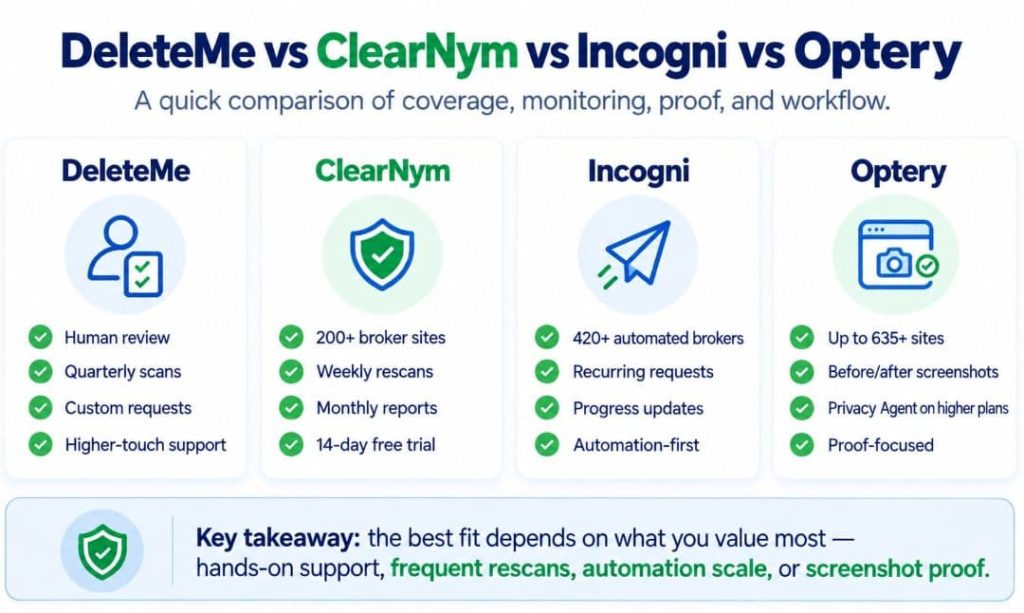
A DeleteMe vs Optery vs Incogni comparison is clearest when it relies on published evidence. Incogni’s current service page says Deloitte verified 420+ data brokers and more than 245 million processed requests. Optery’s pricing page lists 635+ Ultimate sites and before/after screenshots about every 90 days on Extended and higher.
Whether a competitor offers a lower price than DeleteMe depends on household size, billing term, and the features included. Among removal services on the market, users who prioritize weekly rescans can start with ClearNym’s 14-day trial before committing.
Final Verdict — Who Is DeleteMe Best for?
DeleteMe is effective for people who value human-assisted work over the largest automated count. Whether DeleteMe is worth the cost depends on how much time you would otherwise spend checking profiles, completing opt-outs, and revisiting failed cases.
The fit changes by user type:
- Busy individuals: manual review can justify the higher price.
- Families: multi-person plans reduce the per-person rate.
- High-exposure users: Premium adds more scans, requests, and extra sites.
- Proof-focused users: Optery explicitly includes before/after screenshots on higher plans.
- Frequent-monitoring users: ClearNym checks weekly.
- Automation-first users: Incogni covers 420+ automated data brokers.
DeleteMe is an effective option when human exception handling matters. The service is effective at reducing removable exposure, not erasing the entire internet. DeleteMe is better suited to hands-off case management than to users shopping mainly on price.
Key Takeaways
- The service has handled broker opt-outs since 2011.
- The Data Sheet uses identifying fields to match records but excludes SSNs and bank information.
- The published historical directory contains 969 sources; routine plan coverage should be assessed separately.
- Standard is $129 yearly for one person; Premium is $180 and increases scans from four to six, plus custom requests from 40 to 60.
- The first status report arrives in about seven business days, but it is not proof that every record is already gone.
- ClearNym, Incogni, and Optery emphasize different mixes of scan frequency, automation, human review, pricing, and proof.
Value comes from verified work and continued checking, not just a large broker count.
FAQ
Not directly. It can target removable source pages that AI systems may reference, but the AI provider controls when its index, cache, or generated answer changes.
It may reduce some spam by removing exposed phone numbers from broker profiles, but it cannot stop every robocall, leaked marketing list, scam database, or automated dialer.
The account shows case status and reporting details, but the service does not promise a verbatim copy of every outbound request. Ask support when documentation for a specific case matters.
Report the mismatch promptly. Similar names, addresses, or household links can create false matches, and support should investigate the record and correct the mistake.
Yes, it can reduce removable broker exposure for public figures, but it cannot erase lawful news, official records, biographies, or other material without a valid reason or legal basis for removal.
References
- Abine, Inc., “Security.” https://joindeleteme.com/security/
- Abine, Inc., “Member Registration Process.” https://help.joindeleteme.com/hc/en-us/articles/51685309859859-Member-Registration-Process
- Abine, Inc., “Why am I being asked to sign an authorization form?” https://help.joindeleteme.com/hc/en-us/articles/17349613826067-Why-am-I-being-asked-to-sign-an-authorization-form
- Abine, Inc., “Your Privacy Report.” https://help.joindeleteme.com/hc/en-us/articles/8585306360083-Your-DeleteMe-Privacy-Report
- Abine, Inc., “Pricing.” https://joindeleteme.com/pricing/?premium=true
- Abine, Inc., “Choosing Your Plan.” https://joindeleteme.com/blog/choosing-your-deleteme-plan/
- Abine, Inc., “Norton Privacy Monitor.” https://joindeleteme.com/comparisons/norton-privacy-monitor/
- Abine, Inc., “Sites We Remove From.” https://joindeleteme.com/sites-we-remove-from/
- Abine, Inc., “How do I submit a custom removal request?” https://help.joindeleteme.com/hc/en-us/articles/8176349468947-How-do-I-submit-a-custom-removal-request
- Abine, Inc., “What is your refund policy for subscriptions?” https://help.joindeleteme.com/hc/en-us/articles/8171940305683-What-is-your-refund-policy-for-DeleteMe-subscriptions
- Abine, Inc., “How do I delete my account?” https://help.joindeleteme.com/hc/en-us/articles/17837763009939-How-do-I-delete-my-account
- Abine, Inc., “International Plans (Outside of the US).” https://help.joindeleteme.com/hc/en-us/articles/26605119690899-Does-Deleteme-have-International-Plans-outside-of-the-US
- ClearNym, “Plans & Pricing.” https://clearnym.com/pricing
- Incogni, “Data Broker Removal Service.” https://incogni.com/
- Optery, “Pricing for Everyone.” https://www.optery.com/pricing/

Posted by Ava J. Mercer