Opt Out Guides
Advanced People Search Opt Out Guide
Privacy Writer
A. J. MercerAva J. Mercer
Updated
Read
5 min
A listing that shows your name, address, and phone can expose you to spam and scams, which is a privacy risk because the data is publicly visible and accessible. This type of lookup service typically compiles public and commercial sources into one record page.
How to opt out of Advanced People Search
Open the official opt-out page, locate your data, enter an email address or number, and confirm with a code or link to start removal. Processing usually takes 2–7 days, so keep the confirmation message and re-check later.
Checklist:
- Open the official opt-out form
- Enter identifiers (email/phone)
- Complete CAPTCHA/verification
- Confirm via code/link
- Save the confirmation email
- Set a reminder to re-opt-out
Find out if your private details were exposed

have already used our service
Advanced People Search – Quick Facts
| Parameter | Value |
| Domain | advancedpeoplesearch.com |
| Data Types | contact details, addresses, possible social identifiers, relatives, property items, and criminal history (if shown) |
| Opt-out Methods | web form/mail |
| Identity Verification | code via SMS or confirmation message |
| Typical Response Time | 2–7 days |
| Re-listing Risk | medium |
APS is a comprehensive directory that provides access to public records and other compiled sources for an individual, sometimes with detailed reports, and may surface information from data sources that refresh over time. It is sometimes described as a subsidiary of PeopleFinders; removals may run via PeopleFinders. The database can gather updates from third-party data, so periodic checks help protect personal information.
Common data you may find:
- Listed names and known aliases
- Phone numbers
- Contact emails
- Current and past address history
- Relatives and household links
- Property records
- Court records
Step-by-step Guide
Open the official opt-out form
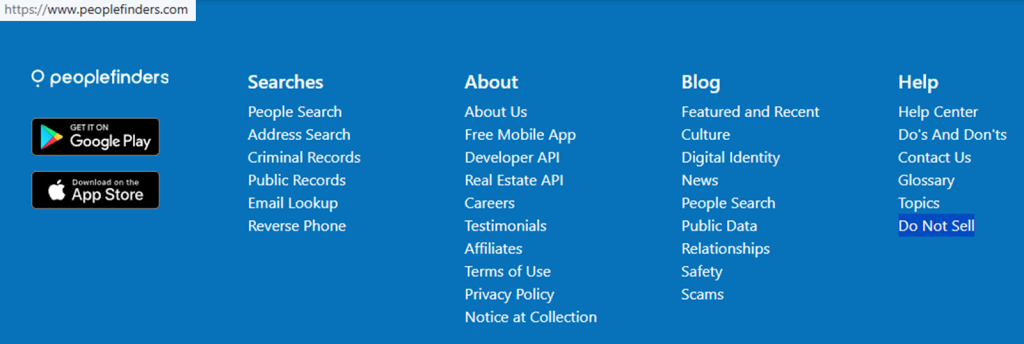
Go to the opt-out page and look for a “Do Not Sell/Share” button. If you arrived from a third-party mention, confirm you are on the correct website before you proceed. Read each field label in detail so you don’t target the wrong record. Tip: Take a screenshot for your notes, but blur personal information before sharing.

Submit your identifiers (email/phone + CAPTCHA)
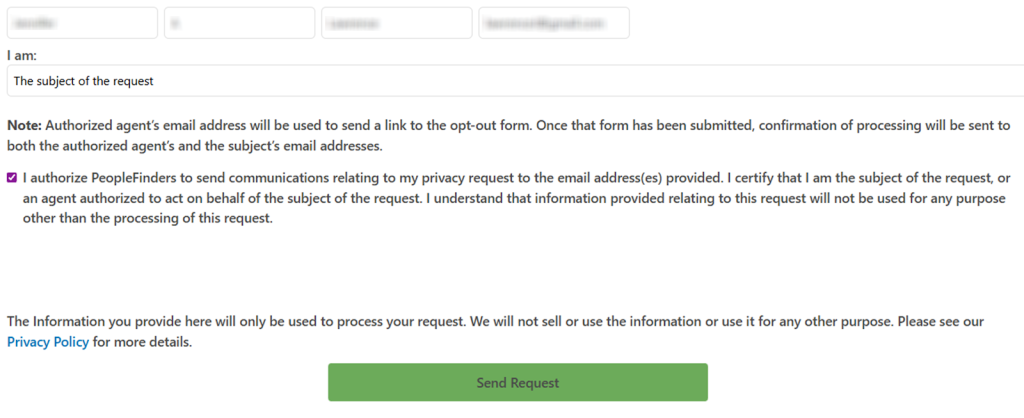
Enter only what the form asks for, then complete the CAPTCHA. Many portals show a results list; open your match and compare details like city, relatives, or address to pick the correct record. When ready, click “Send Request” to remove your information, and note any on-page confirmation. Tip: If there are multiple records, repeat for each one and save each confirmation message. If you see more than one match, open each result and compare street and age hints before you choose.
Verify via code or link (email/SMS)
Check your inbox for a message with a code or a one-time link. If it is missing, look in Spam, then resend once. Save the confirmation message. Tip: Use the same inbox each time, and don’t post screenshots online without redacting personal details. Note the date and any reference number shown after confirmation. If you use a shared inbox, ask an admin to check filters.

Confirm deletion / Do-Not-Sell request
After verification, you should see a confirmation screen that your opt-out was received. Some pages frame this as deletion of a listing; others frame it as a Do Not Sell/Share choice tied to your record. Save that page in detail (date, status text). Tip: If you need help, use the contact option on the website and include the confirmation reference.
Track confirmation & timeline
Keep the confirmation message and set a 3–6 month reminder. If the info is still visible after 7 days, send one follow-up request using the same identifiers. Tip: Keep the profile URL you used so you can compare whether it reappears. This is also a good time to remove your information from other listings tied to multiple data brokers. Store your proof in a dated folder. If you spot a new listing later, repeat the same flow and keep your notes consistent. For an advanced check, review again after a few months.
Timelines, Verification & What to Expect
Most opt-out submissions are processed in about 2–7 days. You may see an on-page status right after you send the form, plus a confirmation message after you verify. Some updates appear within 48 hours, but that is not a promise. If you see no change after 7 days, use the site’s contact channel and include your confirmation details; then follow the guidance you receive. Keep your proof (dates and record details). Keep a simple log of dates, what you saw on-screen, and any redacted screenshots for reference.
Edge Cases & Troubleshooting
- No access to the original inbox/number: use a current inbox/number you control; if the form requires the old one, use the contact page and explain the change; include any confirmation info you have.
- “Record not found”: broaden the query (try a prior city/state) and check name variants; some listings are split across multiple records.
- CAPTCHA or submission errors: turn off VPN/ad blockers, refresh, and try a different browser; if it persists, retry later.
- Verification code not arriving: wait 10 minutes, check Spam/SMS filters, then resend once; avoid repeated attempts.
- Form rejects the opt-out by region (EU/UK/CA): use the privacy contact to ask for the correct path; some tools are US-only.
- Account deletion vs listing removal confusion: delete an account if you have one, but still use the opt-out tool to remove your listing.
- Re-sending after a failed attempt: send again once with matching identifiers and keep each confirmation.
Will my data reappear?
It can. Many data brokers receive new files from aggregators, partner feeds, and resellers, so a removed record may return when fresh personal data is added. Keep your confirmation message, re-check every 3–6 months, and re-submit quickly if the same record shows again. To limit recurrence, start with the biggest sources, then work through related data broker sites. Some data brokers sell your personal information; opting out can help you limit that reuse. Re-listing can also happen when a partner republishes the same profile under a new path or when a crawler indexes an older copy. Set a reminder for 3–6 months, keep your confirmations, and check a few related sites at the same time.
Related removals
- PeopleFinders
- InfoTracer
- Whitepages
- Spokeo
- BeenVerified
- Intelius
Manual vs Assisted Removal
Manual:
- Pros: More control as the user, with documentation for each record you remove; no extra service login needed, and you can focus on one site at a time; useful if you only want to remove your information from a single listing.
- Cons: More time across many data brokers, plus repeat monitoring; more CAPTCHAs and verification steps, which adds friction; you must track confirmations and follow up yourself.
Assisted:
- Pros: Faster coverage across many data brokers, often with a dashboard; ongoing monitoring and repeat checks built in; less manual work when you need help with many listings.
- Cons: Requires sharing identifiers with a third party; coverage varies by provider and data broker sites; you still may need to opt out again if new data appears.
“Excellent”
We remove your data for you - faster, verified, trackable.
Discover Which Sites Share Your Private Details—Instantly and Free.
have already used our service
FAQ
Receive expert privacy advice by email - 1-2 times per month, no fluff.
Share Article

Posted by Ava J. Mercer
Ava J. Mercer is a privacy writer at ClearNym focused on data privacy, data broker exposure, and practical privacy tips. Her opt-out guides are built on manual verification: Ava re-tests broker opt-out processes on live sites, confirms requirements and confirmation outcomes, and updates guidance when something changes. She writes with a simple goal - help readers take the next right step to reduce unwanted exposure and feel more in control of their personal data.
View AuthorMore People Search Removal Guides
- 411.com Opt Out Guide
- Advanced People Search Opt Out Guide
- BeenVerified Opt Out Guide
- CheckSecrets Opt Out Guide
- Find People Fast Opt Out Guide
- GladIKnow Opt Out Guide
- Instant Checkmate Opt Out Guide
- OfficialUSA Opt Out Guide
- PeekYou Opt Out Guide
- PeopleFinders Opt Out Guide
- PeopleSmart Opt Out Guide
- PersonSearchers Opt Out Guide
- Public Data Check Opt Out Guide
- Radaris Opt Out Guide
- SearchPeopleFREE Opt Out Guide
- Social Catfish Opt Out Guide
- Spokeo Opt Out Guide
- ThatsThem Opt Out Guide
- TruthFinder Opt Out Guide
- USA People Search Opt Out Guide
- Whitepages Opt Out Guide