Opt Out Guides
Apollo Opt Out Guide
Privacy Writer
A. J. MercerAva J. Mercer
Updated
Read
5 min
Apollo, like many people search sites, can display business details. These include your name, phone, and address, which may raise privacy concerns. Apollo.io is a B2B data broker that gathers data from publicly available and commercial sources. This step-by-step guide explains how to remove your personal information, including key steps, verification, and timelines. It also covers privacy and security practices and how to reduce re-listing.
How to opt out of Apollo
Visit Apollo’s privacy center, open the opt-out page, enter your email, and verify using a link. The procedure is usually completed in a few days. Keep one short proof for your records.
Checklist:
- Open the official form
- Enter identifiers (email)
- Click the verification link
- Save the email proof
- Set a reminder to re-opt-out
Find out if your private details were exposed

2,865,794 have already used our service
Apollo – Quick Facts
| Parameter | Value |
| Domain | apollo.io |
| Data Types | contact details, company, roles |
| Opt-out Methods | form or email (privacy center) |
| Identity Verification | verification link |
| Typical Response Time | a few days |
| Re-listing Risk | medium |
Apollo is a B2B data broker platform that collects business-related data from public records and trusted providers, letting users search accurate details for sales and marketing.
Common data you may find:
- Names
- Business email address
- Phone number
- Job title and employer
- Work address
- LinkedIn profile
- Company description
- Public work history
Step-by-Step Guide
Open the official opt-out form
Go to Apollo’s privacy center and select Do Not Sell My Info. Use only the official apollo.io form to ensure privacy.
Submit your identifiers (email/phone + CAPTCHA)
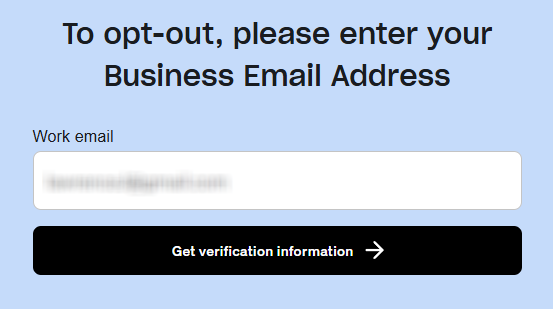
You must submit your business email address. Ensure it is correct before you click submit.
Verify via code or link (email/SMS)
Check your inbox for an email. When you receive the link, click it to proceed with the verification.
Confirm deletion request
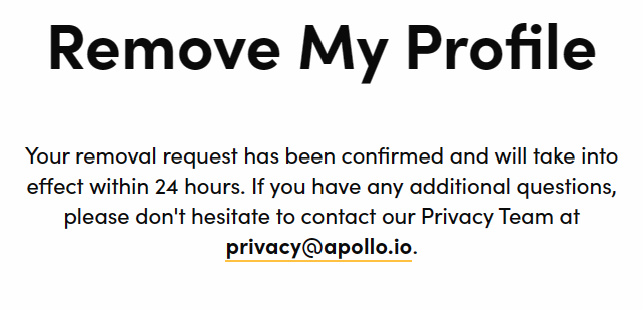
After verification, you’ll see an on-screen notice of processing. Save that for the records.
Track confirmation & timeline
Processing is often within 24 hours, but it may take a few days. If nothing updates, resend once.
Timelines, Verification & What to Expect
Queries are generally completed in one to seven days. Proof appears on the page and in your inbox. If no update appears after a week, resend your request once through [email protected]. Keep the short email trail in a secure folder for future checks.
Edge Cases & Troubleshooting
- Lost email/phone: ask Apollo how to verify another way.
- “Record not found”: try another address.
- CAPTCHA fails: reload or retry later.
- No code/link: check spam, then resend once.
- Region limits: use GDPR or CCPA rights.
- Account vs listing: deleting an account differs from public data removal.
- Retry: wait briefly before resubmitting.
Will my data reappear?
Data brokers continuously update from public sources and partners, so profiles may return. Save your proof and set a reminder to re-check every 3–6 months. If it reappears, re-submit quickly. This reduces the exposure of sensitive information. As a result, this maintains privacy and security.
Related removals
- PeopleFinders
- Intelius
- Spokeo
- Whitepages
- 411.com
- BeenVerified
Manual vs Assisted Removal
Manual:
- Pros: control, no sharing with third parties.
- Cons: takes time, must repeat checks.
Assisted:
- Pros: automated monitoring, verified progress, less effort.
- Cons: possible cost.
“Excellent”
We remove your data for you - faster, verified, trackable.
Discover Which Sites Share Your Private Details—Instantly and Free.
2,865,794 have already used our service
FAQ
Receive expert privacy advice by email - 1-2 times per month, no fluff.
Share Article

Posted by Ava J. Mercer
Ava J. Mercer is a privacy writer at ClearNym focused on data privacy, data broker exposure, and practical privacy tips. Her opt-out guides are built on manual verification: Ava re-tests broker opt-out processes on live sites, confirms requirements and confirmation outcomes, and updates guidance when something changes. She writes with a simple goal - help readers take the next right step to reduce unwanted exposure and feel more in control of their personal data.
76 Articles