Opt Out Guides

Alesco Data Opt Out Guide
See what Alesco Data knows about you
879,225 have already made this search
Privacy Writer
A. J. MercerAva J. Mercer
Updated
Read
5 min
See what Alesco Data knows about you
879,225 have already made this search
Removing your sensitive data from Alesco Data lowers the risk that your name, address, phone, and other personal information are widely shared. This data broker compiles personal data from publicly available information, surveys and questionnaires, and commercial partners into data products and uses this data to market their products. This guide explains how to use the company’s privacy tools, your right to opt out, and options to request the deletion of that personal record with short steps, official links, and timing expectations.
How to opt out of Alesco Data
Visit the official privacy or “Do Not Sell My Personal Information” page, complete a short form with your name and contact details, then confirm a code or link sent to you. The Alesco Data company typically handles requests under the California Consumer Privacy Act and other state privacy laws in about 7–30 days.
Checklist:
- Open the official opt-out form
- Enter identifiers (email/phone)
- Complete CAPTCHA/verification
- Confirm via code/link
- Save the confirmation message
- Set a reminder to re-opt-out
Find out if your private details were exposed

879,225 have already used our service
Alesco Data – Quick Facts
| Parameter | Value |
| Domain | alescodata.com |
| Data Types | contacts, addresses, demographics, property, and marketing segments |
| Opt-out Methods | web form/email/phone |
| Identity Verification | code via email or SMS/a confirmation message |
| Typical Response Time | around 7–30 days |
| Re-listing Risk | medium |
About Alesco Data
Alesco Data is a US-based data broker and marketing provider offering a suite of data products and services that help existing and prospective customers reach audiences. It uses ethical practices for data collection, works with public records, commercial partners, and trusted data compilers. The service may obtain data through public sources to build consumer or business data products that support marketing services.
Common data you may find:
- Names and known aliases
- Email addresses and phone numbers
- Current and past mailing addresses
- Demographic details such as age range or year of birth
- Household, relatives, and other relationship links
- Property or real-estate ownership indicators
- Consumer interests, donation, or purchase categories
- Business and professional firmographic data
- Marketing response or engagement indicators
- Online identifiers connected to offline records
Step-by-Step Guide
Open the official opt-out form
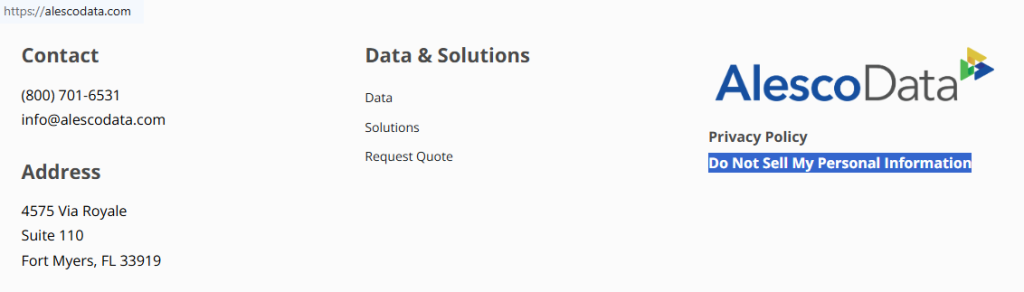
Go to alescodata.com, scroll to the footer, and click “Do Not Sell My Personal Information.” You may be redirected to a service that handles data on behalf of Alesco Data. If you started from a service through a marketing email or a website link, confirm the message clearly refers to this company. Keep screenshots for your records, but blur sensitive details.
Submit your identifiers (email/phone + CAPTCHA)
On the form, enter the personal information needed to find your record: full name, addresses, email, and phone number. Some pages also ask how you want Alesco’s data records handled, such as suppression or deletion. Complete any CAPTCHA, provide only required fields, and avoid uploading IDs unless clearly requested.
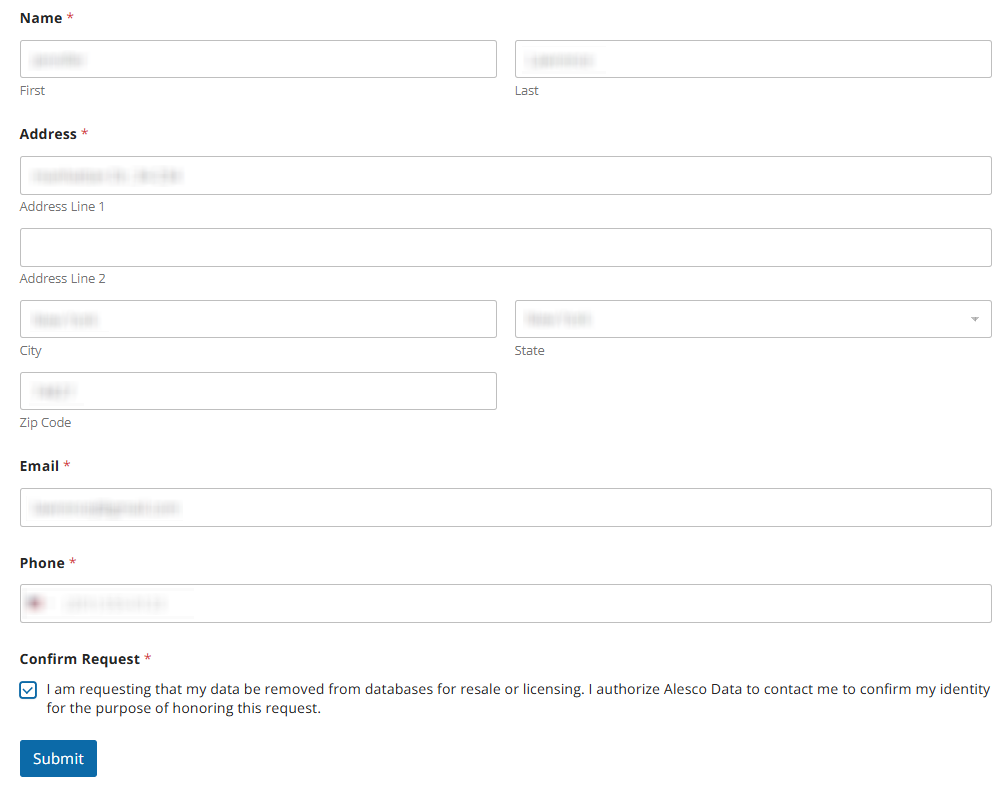
Verify via code or link (email/SMS)
After submitting, you may receive a verification code by SMS or a confirmation link by email. Open it and confirm it refers to the company. Then enter the code or click the button. Check Spam or promotions folders if needed. For safety, never share verification codes, passwords, or any financial account numbers.
Confirm deletion / Do-Not-Sell request
Once verification is complete, review the summary of your choices. The privacy policy explains that Alesco Data will not collect new categories of personal information. It will not use existing records in ways that go beyond the terms of this privacy policy. Confirm your selections, submit the request, and note any reference number shown on the final screen.
Track confirmation & timeline
Receive an email describing how Alesco Data may process personal information. The notice may say that the Alesco Data company and related brands have comprehensive and secure data handling rules and have implemented comprehensive and secure data systems. Save this message and any case number in a safe folder. If you do not see a response within several weeks, search your inbox for the domain. Check any other email accounts you used.

Timelines, Verification & What to Expect
Most requests are acknowledged on-page and by email. Under the California Consumer Privacy Act and related privacy legislation, companies aim to respond within about 30–45 days. If nothing arrives after 45 days, check Spam folders and then follow up using the contact details in the notice. If you still have questions, find the “please email us” button and use the address shown there. You may also request an update if you submitted multiple requests or recently moved.
Edge Cases & Troubleshooting
- No access to original email/phone: Use current contact details and addresses, and note that older identifiers are no longer yours.
- “Record not found”: Try alternate spellings, former addresses, or another email; if still missing, ask support to search manually.
- CAPTCHA or submission errors: Switch browsers or devices, disable script-blockers briefly, then retry or contact support.
- Verification code not arriving: Wait a few minutes, use “resend” once, and check spam or promotions folders.
- Region-based rejections: If the form rejects EU, UK, or Canadian addresses, look for regional contacts and any mention of a data privacy and security act, then write to the listed address.
- Account vs listing confusion: Removing an account with a partner brand does not delete this company’s records; submit a separate privacy request or cancel that listing.
Will my data reappear?
Even after a successful request, your sensitive personal information can reappear when partners refresh feeds. For instance, Alesco Data may update this policy from time to time. Partners may share data products that focus on certain audiences, and customers then utilize this data and utilize this data to market offers. To reduce risk, set a reminder every 3–6 months to search major data sites, keep confirmation messages, and repeat removal requests if new listings appear, so your ongoing security and privacy stay stronger.
Related removals
- 411.com
- Experian Health
- Lookify
- Acxiom
- CoreLogic
- ZoomInfo
- AtData
Manual vs Assisted Removal
Manual:
- Pros: Full control over what personal information you share; no subscription costs or extra accounts.
- Cons: Time-consuming across many data broker sites; needs ongoing monitoring and repeat submissions.
Assisted:
- Pros: Sends many removal requests quickly with a tracking dashboard; helpful for recurring checks on dozens of sites.
- Cons: You must trust another company with your data; results and coverage differ between services.
We remove your data for you - faster, verified, trackable.
Discover Which Sites Share Your Private Details—Instantly and Free.
879,225 have already used our service
FAQ
You see an on-page confirmation and an email summary. Within weeks, the provider reviews your request and either grants access, records Do-Not-Sell, or suppresses/deletes eligible records.
Many privacy-focused users re-check major data broker sites every 3–6 months and re-submit removal requests whenever new listings, moves, or contact changes appear.
Manual requests cost only time and keep control with you. Paid services send many requests and track responses; choose based on your risk, budget, and patience.
They may use ID to stop someone else from abusing your name during deletion or access requests. If you share ID, redact extras, avoid any financial account numbers, and upload only on secure pages.
Processing may finish in weeks, but cached copies and indexes can lag. Expect a few extra weeks before old listings stop appearing in common searches.
Alesco Data is a marketing and analytics provider building audience and contact databases. It gets details from public sources, partners, brands you use, or when you purchase or request information from those companies.
Go to alescodata.com and find “Do Not Sell My Personal Information.” The website allows you to request information, access, deletion, or Do-Not-Sell choices through official forms.
No. Your request affects how Alesco Data uses its datasets and audiences that focus on certain groups. Other companies holding your details still require separate removal requests.
Often you can. Check the privacy notice for regional contacts and any reference to privacy legislation, and if the form rejects your country, email support briefly explaining which rights you believe apply.
Include full name, current and recent addresses, phone, contact address, and request type. Politely state you want records collected and to request deletion, and mention any brands you know used this provider.
Yes. You can request information about a partner’s use of your data, request this information directly from Alesco Data, and ask what categories we’ve collected and to request before deciding on deletion or limits.
Submit a new privacy request and explain that you filed one before but lost the reference. Using the latest form and notice ensures your request is handled under the current policy.

Posted by Ava J. Mercer
More Data Brokers & AdTech Removal Guides
- 33Across Opt Out Guide
- Acxiom Opt Out Guide
- AdDefend Opt Out Guide
- AdElement Opt Out Guide
- AdMarketplace Opt Out Guide
- Adstra Opt Out Guide
- Alesco Data Opt Out Guide
- Allant Group Opt Out Guide
- Anteriad Opt Out Guide
- Appier Opt Out Guide
- Aristotle Opt Out Guide
- Arity Opt Out Guide
- Buyerlink Opt Out Guide
- Complete Mailing Lists Opt Out Guide
- CoreLogic Opt Out Guide
- Data Axle Opt Out Guide
- Epsilon Opt Out Guide
- Exactag Opt Out Guide
- FourLeafData Opt Out Guide
- FullContact Opt Out Guide
- Gemini Opt Out Guide
- Giant Partners Opt Out Guide
- Habu Opt Out Guide
- Kochava Opt Out Guide
- LexisNexis Opt Out Guide
- LiveRamp Opt Out Guide
- Lotame Opt Out Guide
- MediaWallah Opt Out Guide
- Oracle Opt Out Guide
- Outbrain Opt Out Guide
- PacificEast Opt Out Guide
- PeopleConnect Opt Out Guide
- PubMatic Opt Out Guide
- PubWise Opt Out Guide
- Quantcast Opt Out Guide
- Site Impact Opt Out Guide
- Statara Opt Out Guide
- Taboola Opt Out Guide
- VenPath Opt Out Guide
- Verisk Opt Out Guide